Views: 0 Author: Site Editor Publish Time: 2026-09-08 Origin: Site
Vessel sizing dictates the financial survival of any maritime transport operation. Overestimating capacity leads to bloated operational expenditures. You run large vessels with empty seats, burning excess fuel for no return. Underestimating capacity leaves paying passengers on the dock. This damages your reputation and directly cannibalizes revenue. Operators must balance peak commuter demand against off-peak inefficiencies. You also have to navigate strict maritime regulations, terminal infrastructure limits, and complex multi-modal transport needs. Finding the right size requires a strict technical evaluation framework. You cannot guess the numbers. You must align route metrics, regulatory compliance boundaries, construction materials, and hull specifications. This data-driven approach determines the exact vessel size required for a profitable, sustainable operation. We will break down how to evaluate these factors to ensure your fleet matches your actual route demands.
System capacity over individual capacity: Total route throughput (system capacity) depends equally on vessel size and the frequency of sailings; higher frequency with smaller vessels often yields better off-peak economics.
Regulations dictate hard limits: Commercial passenger boat capacity is not determined by floor space alone, but by rigorous stability tests, tonnage limits, and regulatory classifications (e.g., USCG Subchapter T vs. Subchapter K).
Recreational formulas do not apply: The standard "Length × Width ÷ 15" calculation is strictly for small recreational craft; commercial operators must rely on naval architecture and official stability letters.
Right-sizing maximizes ROI: Deploying a targeted 40 passenger ferry boat on a short, high-turnaround route can offer superior margins and lower crewing requirements compared to operating a half-empty 150-passenger vessel.
Materials matter: Hull construction materials (aluminum vs. steel) directly impact the vessel's lightweight, altering the allowable deadweight available for passenger capacity.
Successful ferry route planning starts by establishing baseline daily ridership. You must track peak hour surges and map seasonal fluctuations accurately. Operators often make the mistake of sizing a vessel solely for the absolute peak hour of the year. This approach guarantees massive inefficiencies during the remaining operational hours. Instead, calculate the required hourly throughput. We call this system capacity. System capacity focuses on how many people you move per hour, not just per vessel.
To calculate true system capacity, follow these specific steps:
Measure the absolute peak passenger count during the busiest morning and evening commute hours using automated ticketing data.
Identify the off-peak baseline ridership during mid-day operations to establish minimum viable loads.
Determine the maximum allowable turnaround time at your primary terminals, factoring in mooring and gangway deployment.
Calculate the number of round trips a single vessel can complete in one hour based on transit speed and terminal dwell time.
You must also account for multi-modal transport demands. Passengers rarely travel empty-handed. Commuters bring bicycles, electric scooters, and heavy luggage. Accommodating these items directly cannibalizes available passenger space. If your route serves a heavy cycling community, a vessel rated for 100 passengers might only safely carry 70 people alongside their bikes. You have to measure the deck footprint of light cargo and adjust your usable capacity calculations accordingly. A standard bicycle requires roughly the same deck space as two standing passengers. You need dedicated racks, tie-down points, and wider aisles to prevent trip hazards, all of which reduce your maximum headcount.
Operators face a choice between running one massive vessel infrequently or several smaller vessels frequently. Consider the operational differences between running one 150-passenger vessel every hour versus three 50-passenger vessels every 20 minutes. The single large vessel requires a massive initial capital investment. It demands a larger crew and consumes significant fuel even when running at 20% capacity during mid-day lulls.
High-frequency fleets offer distinct advantages. Deploying multiple smaller vessels improves customer satisfaction. Passengers hate waiting. A 20-minute departure interval provides a massive competitive advantage over alternative land transport. If a commuter misses a boat, they know another arrives shortly. Furthermore, high-frequency models allow you to scale operations dynamically. You can pull one vessel offline for maintenance during off-peak hours without shutting down the entire route.
Running a high-frequency schedule also optimizes your crew shifts. You can keep one or two boats running all day with standard shifts, bringing the third boat online only for the morning and evening rushes. This prevents you from paying a full crew to sit idle on a massive, empty boat at noon. It also provides redundancy; a mechanical failure on a small vessel only reduces your hourly throughput by a fraction, whereas a breakdown on a single large vessel halts your entire operation.
Maritime authorities do not care about your marketing materials. Agencies like the USCG, MCA, and AMSA calculate maximum passenger ferry capacity based strictly on intact and damage stability criteria. Naval architects conduct rigorous inclining experiments to determine how the vessel behaves under load. They shift weights across the deck to simulate passengers crowding to one side during an emergency. The results of these tests dictate your absolute legal limit.
The assumed weight per passenger plays a massive role here. Historically, agencies calculated capacity assuming an average passenger weight of 160 lbs. Modern regulations have updated this figure to 185 lbs or higher. This regulatory shift drastically impacts legacy vessels. A boat legally certified for 150 passengers ten years ago might only qualify for 120 passengers under current stability rules. You must verify the assumed weight metric when evaluating any new build or second-hand vessel.
Operational expenses do not scale linearly. They scale in step-functions based on regulatory thresholds. Crossing specific passenger limits triggers massive increases in your daily operating costs. For example, moving from a 149-passenger vessel to a 150-passenger vessel often pushes the boat into a completely different regulatory subchapter. In the United States, this means moving from Subchapter T to Subchapter K.
This transition requires stricter fire safety systems, heavier structural requirements, and a larger mandatory crew size. You might need to hire licensed engineers instead of standard deckhands. You must map these operational tiers before finalizing your vessel size. Adding ten extra seats might seem like a great way to boost peak revenue. However, if those ten seats force you to hire an additional licensed crew member and install a complex sprinkler system, your profit margins will collapse. Always evaluate the regulatory threshold just below your target capacity to see if a slight reduction saves significant capital.
Do not treat your Certificate of Inspection (COI) as a suggestion. Local Departments of Transport and port authorities strictly enforce passenger limits. They conduct random spot checks and boarding audits. Violating your COI limits results in severe fines, suspended licenses, and grounded vessels. You must implement strict ticketing and boarding protocols to ensure you never exceed the legal headcount.
Furthermore, you must prepare for dynamic capacity restrictions. Your COI might allow 100 passengers in calm waters. However, severe weather, high sea states, or specific route hazards can trigger temporary restrictions. The master of the vessel always retains the authority to restrict allowable capacity below the official limits to ensure safety. Your financial models must account for these potential lost revenue days.
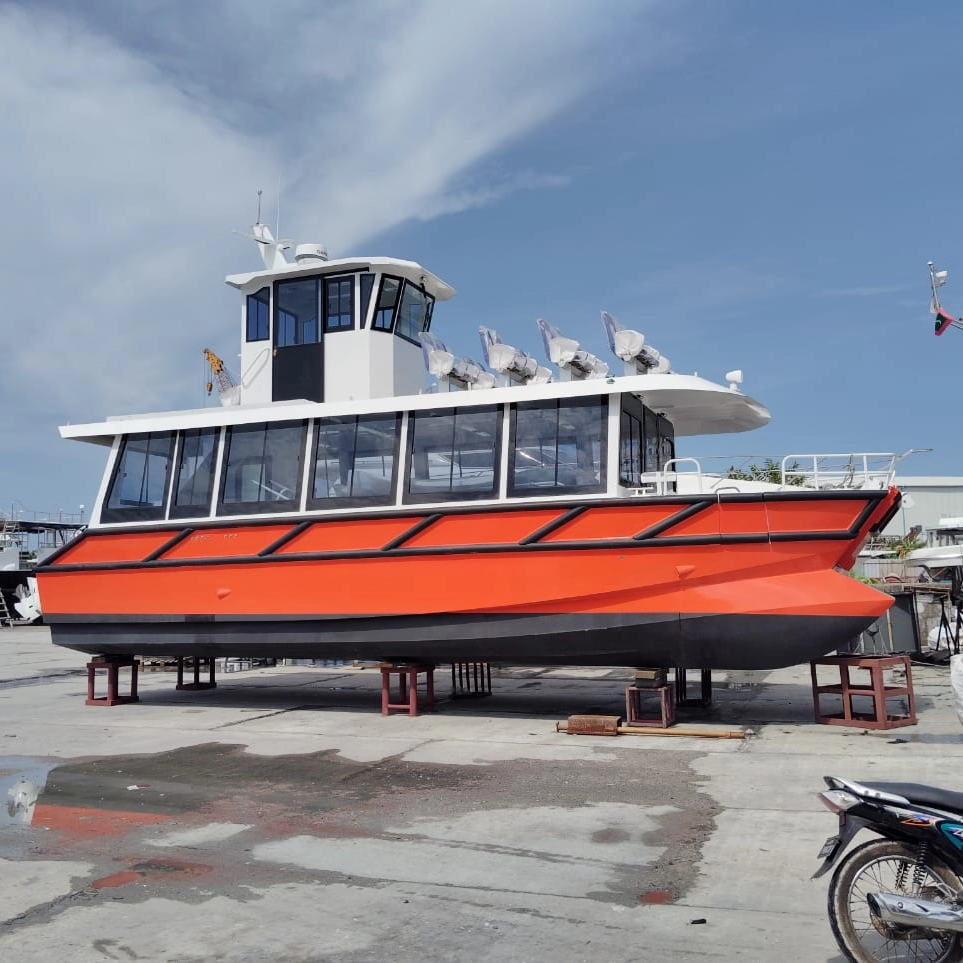
The shape of the hull fundamentally limits how many people you can carry. Catamarans offer a distinct advantage for passenger transport. Their twin-hull design provides a significantly wider beam compared to monohulls of the same length. This wider footprint allows for higher passenger density per foot of length. Catamarans also offer superior initial stability, which helps them pass rigorous regulatory crowding tests more easily.
Deck layout transforms theoretical capacity into practical capacity. You cannot just pack seats edge-to-edge. ADA compliance requires wide aisles and specific wheelchair turning radiuses. Emergency egress routes must remain completely unobstructed. Every required life jacket locker, fire station, and safety briefing area eats into your usable floor space. A poorly designed deck layout can reduce a vessel's legal capacity by 15% or more. You must map out the exact placement of safety gear before finalizing the seating arrangement.
Vessel construction materials directly impact your bottom line. Every pound of structural weight is a pound you cannot use for passengers. Heavy steel hulls offer incredible durability for ice-class operations. However, they consume a massive portion of the vessel's total displacement. This reduces the available deadweight left for passengers, crew, and fuel.
Lightweight marine-grade aluminum offers a superior alternative for most commuter routes. Aluminum hulls drastically reduce the vessel's lightweight. This shift allows for higher passenger deadweight compared to heavier steel hulls of the exact same dimensions. Composite materials also offer excellent weight savings, though they require different maintenance protocols. Choosing the right material ensures you maximize payload without violating stability limits. You must also factor in the long-term maintenance; aluminum requires strict isolation to prevent galvanic corrosion, while steel requires constant coating maintenance to prevent rust.
Route distance changes the definition of a comfortable journey. A five-minute harbor crossing requires nothing more than basic bench seating and standing room. Passengers tolerate high density for short durations. As route distance increases, payload dynamics shift entirely. Longer routes demand extensive onboard amenities to maintain customer satisfaction.
You must install proper restrooms, concession stands, and larger, more comfortable seating for trips exceeding thirty minutes. These amenities cannibalize raw passenger space. A vessel that holds 100 people on a short crossing might only hold 65 people once outfitted for a two-hour coastal transit. You must define the exact service level required for your specific route distance before calculating final capacity.
The micro-ferry segment serves as the ultimate testing ground for new operations. Deploying a targeted 40 passenger ferry boat is ideal for short harbor crossings and validating unproven routes. These vessels keep initial capital requirements extremely low. They also minimize regulatory overhead.
In many jurisdictions, staying under the 49-passenger threshold allows you to operate under less stringent uninspected passenger vessel rules. This reduces mandatory crewing levels and simplifies maintenance schedules. Micro-ferries excel in high-frequency loop routes where rapid boarding and disembarking are critical to maintaining the schedule. They require minimal dock infrastructure and can often utilize existing municipal floating docks without modification.
Mid-size vessels represent the sweet spot for established municipal routes. They balance moderate capital investments with sufficient peak-hour throughput. A well-designed 149-passenger vessel maximizes revenue while staying just below the stringent regulatory requirements triggered at the 150-passenger mark.
These vessels handle moderate sea states better than water taxis. They offer enough deck space to accommodate bicycles and basic amenities without sacrificing too much seating. Operators often rely on mid-size ferries as the backbone of their fleet, deploying them on primary commuter lines during rush hour and scaling back their frequency during the mid-day lull.
High-capacity vessels serve mass transit corridors. These ships require massive infrastructure and significant capital backing. When you cross the 150-passenger threshold, you enter a highly regulated maritime environment. These vessels often integrate vehicle capacity (Ro-Pax), which completely changes the loading dynamics and stability requirements.
Operating high-capacity vessels necessitates deep-water terminals and specialized docking infrastructure. You cannot tie a 300-passenger Ro-Pax ferry to a standard wooden pier. The shoreside investments often exceed the cost of the vessel itself. These ships only generate returns on routes with guaranteed, high-volume daily ridership. Loading and unloading vehicles also drastically increases terminal dwell time, which reduces the number of round trips you can complete in a day.
Mixing different vessel sizes and engine types creates a logistical nightmare. Smart operators examine the operational benefits of standardizing their fleet into specific vessel classes. Large state-run ferry systems use this strategy to control costs and simplify operations. You should aim to build a fleet around two or three uniform capacity tiers.
Standardization simplifies crew training immensely. A captain certified on your 149-passenger catamaran can seamlessly step onto any other vessel in that class. It also streamlines your spare parts inventory. You only need to stock one type of oil filter, one type of alternator, and one type of water pump. When a boat requires unexpected maintenance, you can easily substitute a sister ship without disrupting the published schedule.
Vessel Category | Passenger Range | Primary Use Case | Regulatory Impact |
|---|---|---|---|
Micro-Ferries & Water Taxis | Up to 49 | Short harbor crossings, new route testing, high-frequency loops. | Low overhead. Often qualifies for uninspected vessel tiers. Minimal crewing. |
Mid-Size Commuter Ferries | 50 - 149 | Established municipal routes, peak-hour commuter transit. | Moderate overhead. Maximizes throughput before strict 150+ pax regulations apply. |
High-Capacity & Ro-Pax | 150+ | Mass transit corridors, vehicle transport, long-distance coastal routes. | High overhead. Requires strict Subchapter K (or equivalent) compliance and deep-water terminals. |
You must model the cost per passenger mile meticulously. Fuel consumption represents the largest variable expense in any maritime operation. Pushing a heavy hull through the water requires massive energy. If you operate a large vessel at 20% capacity during off-peak hours, your fuel cost per passenger skyrockets. You are essentially burning diesel to move empty aluminum across the bay.
Right-sized vessels running at 80% capacity deliver incredible fuel efficiency per passenger. You must analyze the engine burn curves provided by the manufacturer. Compare the fuel consumption of running two smaller engines at optimal RPMs against running massive engines at low, inefficient speeds. Matching passenger boat capacity to actual utilization rates prevents you from bleeding cash during the mid-day slump. You should also evaluate the impact of hull fouling on fuel efficiency, as larger wetted surface areas on oversized vessels create more drag over time.
Your vessel size is ultimately capped by the physical limits of your destination. Existing dock sizes dictate the maximum length and beam of your fleet. If your municipal pier only accommodates a 60-foot vessel, you cannot buy an 80-foot catamaran, regardless of route demand. Draft restrictions also play a critical role. Shallow harbors require low-draft vessels, which limits your displacement and, consequently, your payload.
Wake-wash regulations present another hidden constraint. Many inland waterways and crowded harbors strictly limit the size of the wake your vessel can produce. Large, heavy vessels displace more water and create destructive wakes. To comply with local wash rules, you may be forced to operate smaller, lighter vessels or run large vessels at painfully slow speeds, which destroys your schedule reliability. You must conduct a full bathymetric survey of your route to identify any draft or wake limitations before selecting a hull size.
Never purchase maximum-capacity vessels before route demand is proven. This is the fastest way to bankrupt a new maritime operation. Municipalities and private operators often overestimate initial ridership based on optimistic surveys. Launching a massive commercial passenger boat on day one locks you into high capital payments and massive daily operating costs.
You must deploy mitigation strategies. Consider chartering smaller vessels for the first twelve months of operation. This allows you to validate actual ridership data, test different departure schedules, and measure seasonal dips without committing to a multi-million dollar build. Phased fleet expansion reduces financial exposure and ensures your permanent vessels match reality, not projections. You can always sell or reassign smaller vessels once the route matures and demands larger tonnage.
Scaling capacity as demand grows presents a complex engineering challenge. You cannot simply bolt more seats onto an existing deck. Retrofitting existing vessels to increase capacity is often structurally impossible and legally prohibited. Adding passengers changes the center of gravity, requiring entirely new stability tests and regulatory approvals.
Instead of trying to stretch a small boat, plan for scalable frequency. Design your initial terminal infrastructure to handle rapid turnarounds. When demand exceeds your current vessel's capacity, you add another vessel to the schedule rather than attempting a costly retrofit. This approach maintains your standardized fleet classes while efficiently absorbing new ridership. It also prevents you from taking a primary vessel out of service for months to undergo a complex shipyard modification.
Conduct a formal route feasibility study to map exact peak versus off-peak demand and identify multi-modal cargo needs.
Audit your existing terminal infrastructure to determine absolute maximums for vessel length, beam, draft, and wake-wash limits.
Consult with a licensed naval architect to run preliminary stability assessments based on modern assumed passenger weights.
Request detailed lifecycle financial models from shipbuilders that compare the fuel burn of different capacity tiers at 50% and 80% utilization.
A: It is based on rigorous intact and damage stability tests, usable deck space, and strict regulatory formulas governed by maritime authorities like the USCG. Commercial operators cannot use the recreational length-by-width formulas. Naval architects must conduct inclining experiments to determine the absolute safe legal limit.
A: New routes should start with smaller vessels, typically a 40 to 50-passenger boat. This allows operators to test actual market demand, validate schedules, and build ridership while keeping initial capital expenditures and daily operating costs as low as possible.
A: Vessels staying under certain passenger thresholds qualify for less stringent regulatory subchapters. This significantly reduces mandatory crewing levels, simplifies fire safety requirements, and lowers overall construction and maintenance costs compared to vessels carrying 150 or more passengers.
A: It is extremely difficult and costly. Increasing capacity requires a process called re-admeasurement. You must conduct new stability tests, potentially make heavy structural modifications, and secure updated regulatory approvals. Often, the vessel's original hull displacement simply cannot safely support the extra weight.
A: Route planning dictates everything. The route length determines necessary onboard amenities, which eat into seating space. Expected wave heights dictate hull type, and terminal infrastructure limits the maximum draft and beam you can safely deploy.


