Views: 0 Author: Site Editor Publish Time: 2026-09-08 Origin: Site
Commercial ferry operators face a demanding daily balancing act. You must maintain strict maritime compliance while maximizing daily operational efficiency. Relying solely on baseline minimums is a dangerous game. Minimal compliance often exposes your fleet to regulatory delays, serious liability risks, and severe reputational damage. Modernizing a fleet requires careful, strategic decision-making. You must distinguish between basic, obligatory safety equipment and advanced safety systems. These advanced technologies proactively mitigate dangerous crossing hazards, unexpected onboard incidents, and inevitable structural degradation over time. This article provides a comprehensive, evidence-based evaluation of essential passenger ferry boat safety features. We will help you navigate complex maritime certification requirements efficiently. You will learn exactly how to reduce day-to-day operational risk. Ultimately, we will guide you to prioritize your capital investments for a safer, more resilient, and highly reliable fleet.
Strategic investments in commercial passenger boat safety reduce long-term liability and insurance premiums.
Hull material and design (e.g., an aluminum passenger boat or catamaran passenger ferry) dictate baseline stability, survivability, and payload capacity.
Advanced collision avoidance systems are non-negotiable for navigating congested harbors alongside smaller, unpredictable pleasure craft.
Securing passenger boat certification requires documented, scalable systems for fire suppression, evacuation, and crowd management.
Foundational design impacts survivability long before active safety systems deploy. We must carefully assess how hull materials and physical shapes protect passengers. Strong architectural design provides a critical time buffer during unexpected maritime emergencies. Operators should never treat structural integrity as an afterthought. It determines how well a vessel handles adverse weather and unexpected impacts.
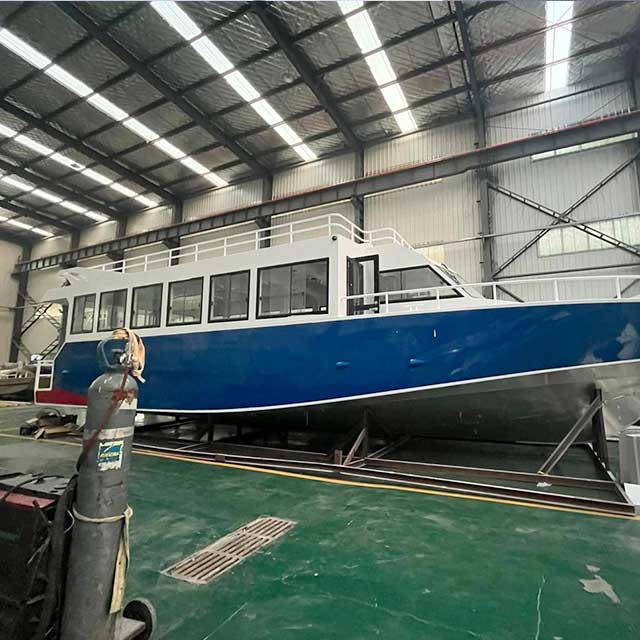
Many modern operators specify an aluminum passenger boat for their fleets. This material offers a vastly superior strength-to-weight ratio compared to traditional steel. A lighter hull significantly reduces the overall vessel draft. A shallower draft improves maneuverability greatly in shallow waters or debris-heavy rivers. It allows captains to navigate tight harbors confidently.
However, implementation reality dictates careful planning. Aluminum behaves quite differently than steel in saltwater environments. It requires specific galvanic corrosion mitigation strategies. You must install sacrificial anodes and isolate dissimilar metals carefully. Furthermore, aluminum loses structural integrity at lower temperatures than steel. Therefore, you must install specialized structural fire-boundary insulation to meet safety codes.
Stability remains paramount for passenger safety and comfort. A catamaran passenger ferry provides enhanced initial stability. The dual-hull design significantly reduces uncomfortable transverse rolling motions. This layout naturally prevents motion sickness among civilian passengers.
Beyond comfort, this design offers vital built-in redundancy. You benefit from split engine rooms located in separate hulls. They also feature entirely separate fuel systems. These isolated mechanical systems drastically lower the risk of catastrophic capsize. If one hull suffers damage, the other maintains propulsion and electrical generation.
Naval architects must evaluate cross-flooding arrangements rigorously. When a hull breaches, asymmetric flooding causes dangerous listing. Cross-flooding ducts quickly equalize the water distribution across the vessel. This action keeps the deck level during an evacuation sequence.
Bilge pumping capacities must meet strict domestic and international survivability standards. Proper watertight compartmentalization keeps a damaged vessel afloat longer. It isolates localized flooding to very specific, contained zones. You must ensure crew members maintain watertight doors properly. Faulty seals compromise the entire compartment strategy during a real crisis.
Engine room fires represent a massive threat to commercial vessels. Passenger deck hazards also frequently cause devastating ferry losses. Containment systems must operate independently and reliably. They cannot rely on external harbor assistance during a voyage. A fire at sea demands immediate, effective onboard action.
Operators must evaluate water mist systems carefully against traditional sprinklers. High-pressure water mist provides rapid environmental cooling capabilities. It deploys micro-droplets absorbing heat much faster than standard water streams. Importantly, mist systems result in much lower water accumulation on decks. Less water accumulation preserves delicate vessel stability during a major event.
Engine room smothering requires a different approach. We assess clean agent systems like Novec or FM-200. We compare them directly against traditional CO2 systems. Clean agents allow much faster passenger evacuation timelines. They are safe for human exposure during the initial discharge phase. They also involve much lower system reset costs. Conversely, CO2 requires complete space evacuation before discharge due to lethal asphyxiation risks.
System Type | Primary Benefit | Impact on Vessel Stability | Evacuation Requirement |
|---|---|---|---|
High-Pressure Water Mist | Rapid cooling, uses minimal water | Low risk (minimal water weight added) | Immediate (safe for occupants) |
Traditional Sprinklers | Proven reliability, simple mechanics | High risk (heavy water accumulation) | Immediate (safe for occupants) |
Clean Agents (Novec/FM-200) | No residue, protects electronics | No impact (gas deployment) | Short delay (safe but startling) |
CO2 Smothering | Cost-effective for large spaces | No impact (gas deployment) | Mandatory full evacuation first |
Passive fire protection remains incredibly important. A-Class and B-Class fire-resistant bulkheads are vital components. They create necessary safe havens onboard the vessel. These rated barriers protect primary evacuation routes from smoke and intense heat. They give your crew members valuable time to manage the incident safely.
Frequent false fire alarms are incredibly dangerous. They quickly degrade crew responsiveness over time. Alert fatigue causes crew members to hesitate during actual emergencies. Operators must select detection systems featuring robust diagnostic panels. Low false-positive rates are essential for maintaining constant, sharp vigilance onboard.
Ferry operators face acute daily risks from surrounding traffic. Unpredictable smaller vessels frequently cross dedicated ferry transit paths. Pleasure craft in high-traffic harbors often behave erratically. Their operators may not understand commercial maritime right-of-way rules. You need highly reliable systems to track them continuously.
Bridge technology forms your primary defense against collisions. You must integrate AIS (Automatic Identification System) seamlessly into your bridge console. Combine this data alongside your ARPA (Automatic Radar Plotting Aid) displays. ARPA tracks moving targets and predicts their future positions accurately.
Add thermal imaging cameras to your sensor suite. These specialized tools classify unlit targets effectively in low visibility conditions. They detect small fiberglass boats invisible to standard radar systems. Thermal sensors cut through dense harbor fog effectively.
Modern ferries utilize ECDIS (Electronic Chart Display and Information System) extensively. Captains use it to establish strict virtual safety corridors. The system calculates the Closest Point of Approach (CPA) automatically. This calculation gives captains early warnings about potential collision courses. It allows smooth, early course corrections rather than sudden evasive maneuvers.
Technology cannot ever replace excellent bridge resource management (BRM). Human oversight remains absolutely critical for safe navigation. Operators must evaluate the user interface (UI) of bridge systems closely. Poorly designed interfaces cause severe alert fatigue and confusion. You must ensure clear human-in-the-loop decision-making during critical moments.
Here are crucial best practices for effective bridge management:
Conduct regular scenario-based simulator training for all deck officers.
Standardize clear communication protocols among the bridge crew.
Rotate radar monitoring duties frequently to prevent visual fatigue.
Cross-reference electronic sensor data against direct visual observations constantly.
Establish strict "sterile bridge" rules during complex harbor maneuvers.
Systems must account for the unpredictable nature of civilian passengers. Crisis situations always trigger chaotic human behavior. Prioritize highly intuitive egress pathways throughout the vessel. Your structural designs must actively reduce passenger panic. Clear guidance saves lives during the crucial first ten minutes.
We evaluate Marine Evacuation Systems (MES) against traditional options carefully. MES utilize inflatable chutes and large slides. They deploy rapidly at the push of a button. They require very few crew members to operate effectively. This efficiency frees up staff for fire containment or crowd management.
Traditional davit-launched life rafts take significantly longer to launch. They require complex mechanical steps. They also demand higher crew-to-passenger ratios for safe boarding. MES usually streamlines the entire evacuation process significantly. It allows hundreds of passengers to board rafts in mere minutes.
Proper physical infrastructure guides passengers safely through smoke-filled corridors. Install photoluminescent pathway marking continuously on all lower decks. These passive glow-in-the-dark strips require no electrical power. They remain visible even during complete blackout conditions.
Implement intelligent PA systems immediately across your fleet. These systems should provide pre-recorded, multilingual automated instructions. Automated voices sound calm and authoritative during a crisis. Apply high-quality anti-slip deck coatings universally. Wet, tilting decks cause severe injuries during chaotic evacuations.
Design your primary muster areas strategically. They must accommodate your maximum passenger capacity easily. Ensure panicked crowds do not disrupt critical crew movements. Crew members need completely unobstructed access to emergency command stations. Muster stations should feature clear signage and dedicated life jacket storage lockers.
Safety features face rigorous, periodic inspections by maritime authorities. Assessors judge their ability to maintain active operating status. Passing these strict audits is non-negotiable for your fleet. Non-compliance results in immediate operational suspension and lost revenue.
You must align your fleet specifications carefully. Follow international IMO (SOLAS) guidelines closely for large vessels. Adhere to strict USCG Subchapter K or Subchapter T rules domestically. Comply fully with all equivalent local port authority regulations. Each jurisdiction demands specific technical documentation.
Physical safety features require proper, continuous documentation. You must integrate them into a recognized Safety Management System (SMS). The ISM Code provides a strong, internationally recognized framework. Continuous risk assessment keeps your daily operations compliant. It forces crews to document maintenance routines rigorously.
A robust SMS includes several key elements:
Documented procedures for mandatory safety drills and crew training.
Detailed reporting protocols for near-miss incidents and equipment failures.
Scheduled maintenance logs for all critical lifesaving appliances.
Clear hierarchical lines of communication between the vessel and shoreside management.
Audit your current fleet thoroughly today. Anticipate upcoming regulatory shifts proactively. Prepare for pending fire safety mandates before they become law. Monitor emissions-related safety updates closely, as alternative fuels introduce new fire risks. You must adapt your safety protocols to match new propulsion technologies.
Prioritize retrofits offering clear dual benefits. They should satisfy strict regulatory requirements seamlessly. Simultaneously, they must reduce the daily operational burden on your crew. Automating safety checks through digital panels saves thousands of man-hours annually.
Effective commercial ferry safety requires a deeply holistic approach. It starts directly from foundational hull design. Choosing a catamaran layout or aluminum construction sets your baseline survivability. You then layer advanced active systems logically on top. State-of-the-art fire suppression and digital collision avoidance complete the modern safety net. Protecting human life remains the ultimate metric of operational success.
Your next steps dictate your future fleet readiness. Conduct a comprehensive gap analysis of your current fleet immediately. Consult directly with qualified naval architects regarding structural upgrades. Engage compliance specialists for thorough, independent audits. Finally, evaluate the real benefits of retrofitting older vessels versus commissioning entirely new builds.
A: Mandatory features depend strictly on vessel class and passenger count. However, universal mandates apply broadly. You must carry sufficient life rafts and approved personal flotation devices (PFDs) for everyone onboard. Active fire detection systems are legally required. AIS (Automatic Identification System) is obligatory for commercial harbor navigation. Finally, vessels must demonstrate basic stability compliance during annual regulatory inspections.
A: A catamaran provides a much wider beam overall. This creates superior transverse stability and prevents severe rolling in rough seas. It offers significantly larger deck space for safer passenger management and easier evacuation. Furthermore, the dual-hull design provides critical mechanical redundancy. If one hull experiences localized flooding or complete engine failure, the other maintains operational control.
A: Software and sensor upgrades are highly cost-effective. Adding AIS, thermal cameras, and digital charting yields immediate navigation benefits. However, structural modifications present major financial challenges. Upgrading foundational fire-boundary insulation or altering watertight compartments is often cost-prohibitive. In these specific cases, operators usually find commissioning a completely new vessel makes better financial sense.


