Views: 0 Author: Site Editor Publish Time: 2026-09-30 Origin: Site
passenger capacity acts as the primary engineering variable for any commercial ferry build. It dictates naval architecture, stability parameters, and propulsion sizing from day one. Misjudging passenger demand introduces severe operational hazards. If you overestimate capacity, you inflate capital expenditure and burn excess fuel pushing an empty hull through the water. If you underestimate it, you create revenue bottlenecks, accelerate mechanical wear, and risk failing safety compliance checks during peak seasons.
This guide provides a technical evaluation framework for fleet operators and marine procurement teams. We break down how to align your capacity requirements with hull selection, seating configurations, and regulatory mandates. You will learn practical engineering trade-offs to ensure your vessel remains operationally viable, structurally sound, and safe across its entire service life.
Capacity Dictates Hull Architecture: The choice between monohull and multi-hull designs, as well as construction materials, is directly downstream of required passenger volume, stability requirements, and route conditions.
Layout Impacts Turnaround Times: An optimized passenger boat seating layout balances maximum payload with rapid, safe embarkation/disembarkation, directly affecting daily route frequency and transit network integration.
Compliance Scales with Capacity: Regulatory requirements for life-saving appliances (LSA), structural fire protection, and ADA accessibility increase exponentially as passenger capacity thresholds are crossed.
Safely supporting dynamic human weight across varying deck levels presents a complex engineering challenge. Naval architects must balance maximum payload without compromising the vessel's center of gravity. Passengers are not static cargo. They move, congregate, and shift the vessel's balance unpredictably during transit.
Engineers rely on strict industry-standard metrics for passenger weight assumptions. Regulatory bodies typically mandate calculating each passenger at 75 kg to 85 kg, depending on the route profile and expected luggage allowances. A 300-passenger ferry carries over 22 metric tons of human payload. This weight does not sit still.
The "free surface" of decks must accommodate this dynamic shifting. When a vessel passes a scenic landmark or approaches a dock, passengers naturally crowd to one side. This creates a massive heeling moment. Designers calculate the intact stability to withstand this crowding effect without exceeding safe roll angles. If the righting arm (GZ curve) is insufficient, the vessel risks capsizing under asymmetrical loading.
Loading Scenario | Engineering Impact | Design Mitigation |
|---|---|---|
Static Seated Load | Baseline displacement and draft calculation. | Distribute seating evenly across the longitudinal center of buoyancy. |
Dynamic Crowd Shift | Induces severe heeling moment and reduces transverse stability. | Increase beam width or integrate active fin stabilizers. |
Emergency Mustering | Concentrates maximum weight at specific evacuation stations. | Reinforce deck structures at muster stations and widen adjacent scuppers. |
Winter Gear/Luggage | Increases average weight per passenger by up to 10 kg. | Apply higher regulatory weight assumptions during the initial stability modeling. |
Adding upper decks increases passenger capacity but significantly raises the vessel's vertical center of gravity (KG). A higher center of gravity reduces the metacentric height (GM). When GM is too low, the vessel becomes tender, resulting in slower, deeper rolls. This degrades passenger comfort and induces seasickness, which directly impacts ticket sales on tourist routes.
To counteract a high center of gravity, builders implement specific structural trade-offs. They often increase the beam width to restore transverse stability. Alternatively, they integrate active stabilization systems like interceptors or T-foils. These additions maintain a comfortable roll period but increase hydrodynamic drag and mechanical complexity below the waterline.
Evaluating primary hull forms requires matching the architecture to your expected passenger volume. The right passenger boat hull design scales efficiently with demand while handling specific route conditions, wave heights, and terminal restrictions.
Monohulls offer excellent seakeeping in heavy-sea routes. They cut through waves efficiently and provide a predictable roll motion. However, monohulls face severe limitations in deck space relative to their overall length. The bow tapers sharply, reducing usable square footage. Increasing capacity on a monohull usually requires adding length or stacking decks, which complicates stability and increases the required draft.
The catamaran passenger boat represents the industry standard for high-capacity, high-speed ferries. A catamaran splits the displacement across two demi-hulls. This configuration creates a massive, rectangular main deck. It maximizes square footage for seating without proportionally increasing the draft. The wide beam delivers exceptional transverse stability, easily absorbing the heeling moment of a shifting crowd without requiring deep ballast.
Hull Characteristic | Monohull Application | Catamaran Application |
|---|---|---|
Deck Space Efficiency | Moderate. Tapers at the bow, limiting forward seating. | High. Broad and rectangular from bow to stern. |
Transverse Stability | Relies on deep draft, ballast, or active stabilizers. | Excellent inherent stability due to wide beam footprint. |
Draft Requirements | Deeper draft required as passenger capacity increases. | Shallow draft maintained even with high passenger loads. |
High-Speed Efficiency | Requires massive horsepower to overcome hull speed limits. | Low wave-making resistance allows higher speeds with less power. |
High passenger loads heavily influence the choice of construction materials. Marine-grade aluminum provides a superior capacity-to-weight ratio. It remains lightweight, reducing overall displacement. This makes aluminum the preferred choice for high-speed, high-capacity commuter ferries where fuel efficiency and shallow drafts are operational priorities.
Steel offers unmatched durability and impact resistance. It suits displacement hulls operating in heavy weather, debris-filled rivers, or ice-prone regions. However, steel is heavy. Using steel for a high-capacity vessel increases the draft significantly. You must install more powerful engines to push a fully loaded steel ferry at the same service speed as an aluminum counterpart.
Higher passenger capacities naturally increase vessel displacement and draft. You must evaluate the constraints imposed by your existing docking facilities before finalizing a design. A deep-draft monohull carrying 400 passengers might require expensive terminal dredging or pier extensions.
Shallow water routes demand careful hull selection. Upgrading fleet capacity often forces operators to redesign terminals if the new vessels draw too much water. A catamaran mitigates this risk by distributing the heavy passenger payload over a wider footprint, keeping the draft shallow enough to utilize existing shoreside infrastructure.
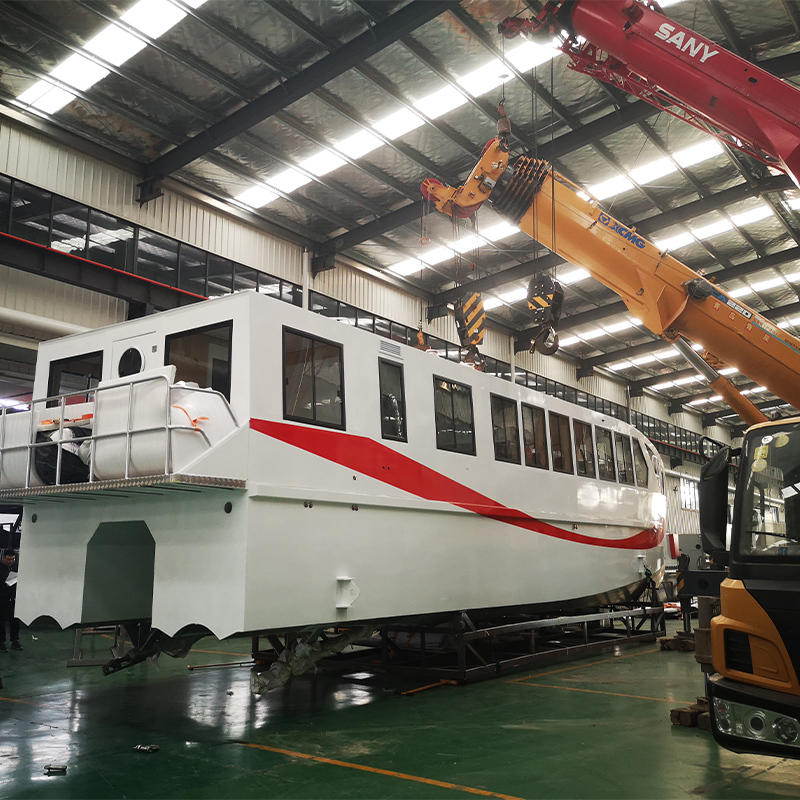
Seating configurations directly impact operational efficiency, passenger experience, and shoreside logistics. The passenger boat seating layout must balance maximum density with rapid, safe movement during boarding and evacuation.
Short-hop commuter ferries prioritize maximum capacity. They utilize high-density layouts with tighter seat pitches and narrower aisles. The goal is moving the maximum number of people over a short duration where long-term comfort is secondary. These layouts often feature durable, hard-shell seating that withstands heavy daily wear.
Long-distance tourist routes require a different approach. They prioritize comfort, offering wider seats, generous legroom, and integrated amenities like tables and charging ports. Many operators now utilize modular track-seating systems. These systems allow deck crews to adjust the layout based on seasonal demand, swapping dense commuter rows for spacious tourist seating during the summer months without requiring structural modifications.
Layout bottlenecks destroy embarkation and disembarkation speeds. If a high-capacity vessel takes too long to unload, you lose daily route frequency. Efficient flow requires deliberate design choices integrated into the general arrangement drawings.
Dual-Aisle Configurations: Implement two main longitudinal aisles to prevent single-file bottlenecks during offloading.
Optimized Gangway Placements: Align interior aisles directly with midship or oversized bow doors for straight-line exiting.
Clear Wayfinding: Use color-coded deck zones and clear signage to direct passengers quickly to available seats.
Luggage Storage Zones: Place dedicated luggage racks near the entrances to prevent bags from blocking narrow aisles.
Shoreside Integration: Design the rapid offloading sequence to match the capacity of waiting buses, trains, or parking shuttles to prevent terminal congestion.
Mandatory design inclusions scale with capacity tiers. High-capacity vessels must ensure seamless wheelchair maneuverability. This requires wider main aisles, ramped thresholds, and turning radii compliant with accessibility standards. You cannot simply place wheelchairs in the aisles; dedicated tie-down stations must be integrated into the deck plan.
Multi-deck vessels face stricter requirements. You must integrate marine elevators or platform lifts to ensure all passengers can access amenities on upper decks. Accessible restrooms require specific square footage and grab-bar reinforcements. These mandatory spaces subtract from the overall revenue-generating seating footprint, requiring careful spatial planning.
Capacity, speed, and operational costs intersect sharply during the design phase. Effective ferry boat customization requires balancing these conceptual trade-offs to achieve a viable operational profile that meets daily schedule demands.
Adding passenger weight creates a non-linear demand on propulsion. As displacement increases, the wetted surface area of the hull increases, generating more hydrodynamic drag. Maintaining a strict service speed with a heavier payload requires exponentially more horsepower. Up-sizing propulsion systems to handle peak passenger loads impacts both initial capital expenditure and daily fuel consumption.
Operators must analyze engine load profiles carefully. Running massive engines at low loads during off-peak, low-capacity runs causes carbon buildup, cylinder glazing, and accelerated mechanical wear. Customization should focus on matching the engine's most efficient RPM band with the vessel's average passenger load, rather than sizing exclusively for absolute peak capacity.
Modern customization increasingly includes hybrid-electric or fully electric propulsion. Heavy passenger payloads directly impact battery range. Marine batteries add massive weight to the hull. Engineers must trade passenger capacity for battery banks to maintain stability and speed. A ferry designed for 300 passengers on diesel might only safely carry 250 passengers if retrofitted with heavy battery racks.
Digitalization optimizes these loads in real-time. Digital passenger counting systems and weight distribution sensors feed data directly to the bridge. This allows the crew to adjust active trim systems, optimizing fuel efficiency based on exactly where passengers are sitting. Emerging autonomous docking technologies further reduce turnaround times, ensuring safe, rapid approaches regardless of how the payload impacts vessel handling.
Strict regulatory frameworks trigger automatically based on specific passenger counts. Maritime authorities classify vessels based on these thresholds, dictating construction materials, safety standards, and inspection frequencies.
Capacity dictates the volume, placement, and deployment mechanisms of all life-saving appliances. A vessel carrying 50 passengers might rely on simple throw-over liferafts and standard lifejackets. A vessel carrying 400 passengers requires complex Marine Evacuation Systems (MES) with inflatable slides and high-capacity boarding platforms.
Mathematical requirements govern clear deck space and stairwell widths. Regulations mandate maximum evacuation time limits. Staircases must be wide enough to allow a specific flow rate of passengers per minute. If you increase capacity, you must widen the stairs. Wider stairs reduce the available seating area on the main deck, forcing a compromise between capacity and revenue space.
High-capacity vessels require advanced fire zone subdivisions. The hull and superstructure must be divided by A-class fire boundaries (such as A-60 bulkheads) that contain smoke and heat for specified durations. You must install automated fire suppression systems, which add weight, piping complexity, and maintenance requirements to the build.
Expected passenger loads also impact safe operating parameters in heavy weather. Intact stability criteria dictate how the vessel behaves when fully loaded in extreme sea states. Overloaded vessels lose reserve buoyancy. Regulatory bodies strictly limit the wave heights and wind speeds a high-capacity ferry can navigate to prevent catastrophic stability loss during a storm.
Procurement errors in capacity planning carry massive financial consequences. Decision-makers must navigate these implementation risks carefully to avoid stranding capital in the wrong asset.
Relying on a single massive vessel introduces severe operational risk. If a 500-passenger ferry suffers a mechanical failure, the entire route shuts down. Furthermore, running a massive vessel during low-demand periods destroys profit margins due to high fuel burn and crew costs.
Mitigate this by aligning fleet size with market demand modeling. Operating two 250-passenger ferries often provides better flexibility. It allows high-frequency departures during rush hour and permits taking one vessel offline for scheduled maintenance without halting service entirely.
Operating a half-empty, high-capacity vessel creates a financial drain. You burn fuel pushing unnecessary displacement through the water. You also pay for mandatory crew minimums dictated by the vessel's maximum certified capacity, not the actual ticket sales for that specific voyage.
Mitigate this risk through rigorous market feasibility studies. Model the route demand accurately before finalizing the build sheet. Do not build for a once-a-year peak event at the expense of daily operational efficiency.
Outgrowing a vessel too quickly leads to passenger left-behinds. This damages your brand and invites competitors to take your overflow. Premature fleet expansion requires massive sudden capital investment that disrupts cash flow.
Mitigate this by designing vessels with flexible, multi-use deck spaces. Alternatively, specify a hull design that accommodates future lengthening. Jumboisation—cutting the vessel in half and inserting a new mid-body section—is a proven method to increase capacity later if the original naval architecture accounts for the added bending moments.
Commission a route-specific feasibility study to quantify exact peak and off-peak passenger demand before drafting initial vessel specifications.
Require your naval architect to provide intact and damage stability calculations for both static and dynamic passenger loading scenarios.
Specify modular track-seating systems in your general arrangement drawings to allow for seasonal capacity adjustments without structural modifications.
Evaluate propulsion packages based on the engine's specific fuel consumption at your average daily passenger load, rather than absolute peak capacity.
A: Catamarans provide a wider beam, creating a large rectangular deck space that accommodates high passenger counts without requiring a deep draft. Monohulls taper at the bow, limiting usable deck area. To match a catamaran's capacity, a monohull must be significantly longer or stack multiple decks, which raises the center of gravity and complicates stability.
A: Regulatory rules compound as capacity increases. For example, the USCG shifts vessels from Subchapter T (under 150 passengers) to the much stricter Subchapter K (over 150 passengers). Higher tiers mandate advanced structural fire protection, complex evacuation systems, and increased minimum crew levels.
A: Regulations vary by jurisdiction, but standard metrics typically require specific square footage per person. Seated passengers require defined seat pitch and width. Standing passengers and emergency muster areas often require roughly 0.25 to 0.85 square meters per person to ensure safe movement and stability.
A: Yes, if the vessel utilizes modular track-seating systems. Operators can swap dense commuter seating for spacious layouts. However, any significant layout modification must be re-certified by regulatory bodies to ensure it still meets stability requirements and evacuation time limits.
A: Passenger weight directly increases the vessel's displacement. Heavier displacement creates more hydrodynamic drag. The engines must work harder and burn more fuel to maintain the required service speed. Over-specifying capacity means you constantly burn extra fuel to push unused vessel weight.
A: Maritime authorities mandate minimum safe manning levels based directly on the maximum certified passenger capacity. Higher capacities require more deckhands and officers to manage emergency evacuations and crowd control, regardless of how many passengers are actually on board during a specific trip.


