Views: 0 Author: Site Editor Publish Time: 2026-10-06 Origin: Site
Choosing between a 30 and 40 passenger vessel represents a critical business decision. It is never just a simple matter of bolting down 10 extra seats. This choice significantly impacts regulatory compliance, daily operating margins, and mandatory crew requirements. Commercial operators managing tourism routes, municipal transit, or private charter services face a delicate balancing act. You must accurately match your vessel capacity to your actual route demand. Doing so dictates your long-term financial health and determines your break-even timelines. You need a reliable vessel. It must serve your passengers efficiently while fiercely protecting your bottom line. Buying too much boat burns cash rapidly. Buying too little leaves profit stranded on the dock. This guide provides a clear, evidence-based evaluation framework. It helps operators weigh the stark operational realities of a 30 vs 40 passenger ferry boat. We will explore the nuanced differences in safety regulations, daily utilization rates, and long-term expenses. By the end, you will understand exactly which capacity maximizes your profitability.
A 10-passenger capacity increase often triggers stricter maritime compliance standards and higher crew-to-passenger ratio requirements.
A 30 passenger boat offers a lower break-even point, ideal for year-round routes with fluctuating seasonal demand.
A 40 passenger ferry boat maximizes peak-season revenue but requires careful consideration of hull stability (often favoring catamaran designs).
Final procurement decisions should be based on historical route utilization rates, not just maximum theoretical revenue.
Maritime authorities heavily regulate commercial passenger vessels globally. When you cross specific passenger thresholds, the operating rules change drastically.
Agencies like the US Coast Guard determine official passenger boat capacity through strict calculations. They do not just count available seats. They evaluate gross weight limits, available deck space per person, and crucial stability metrics. Adding 10 passengers adds significant physical weight. It shifts the center of gravity higher above the waterline. This requires a much higher stability rating. Builders must conduct complex inclining experiments to prove the hull can handle the dynamic load.
Moving from 30 to 40 passengers often pushes you across a strict regulatory line. Authorities usually mandate an additional deckhand once you exceed a certain passenger count. Your captain may also need specialized, higher-tonnage certifications. More crew members mean higher daily payroll expenses. You must pay these wages regardless of how many tickets you actually sell that day.
You must carry extra lifesaving equipment to comply with the law. Every additional passenger requires certified life rafts and commercial-grade personal flotation devices (PFDs). Life rafts require expensive annual repacking and mandatory inspections. Furthermore, these additions compound your commercial marine insurance premiums. Underwriters view larger crowds as higher liability risks. They will price your commercial policy accordingly.
Smaller vessels offer distinct and powerful operational advantages. They prioritize route agility over sheer passenger volume.
A 30 passenger boat routinely operates near full capacity. Filling 30 seats is substantially easier than filling 40. This high utilization rate ensures profitable margins even during off-peak shoulder seasons. When tourist traffic drops in the autumn, a smaller boat remains economically viable. You avoid the pressure of discounting tickets just to cover your daily fuel costs.
These boats boast an excellent operational footprint. You gain tremendous docking flexibility at smaller, older marinas. They typically feature shallower drafts. This allows safe access to restricted coastal waterways and shallow tidal estuaries. Captains maneuver them easily in crowded harbors. They require less engine power to fight strong crosswinds during docking procedures.
Boutique coastal tours focusing on personalized, premium experiences.
Private event charters for corporate retreats or intimate weddings.
Point-to-point transit routes featuring high-frequency, lower-volume commuter demand.
Operators facing strict harbor size restrictions or limited slip availability.
You run a leaner operation overall. It responds quickly to changing market conditions without bleeding working capital.
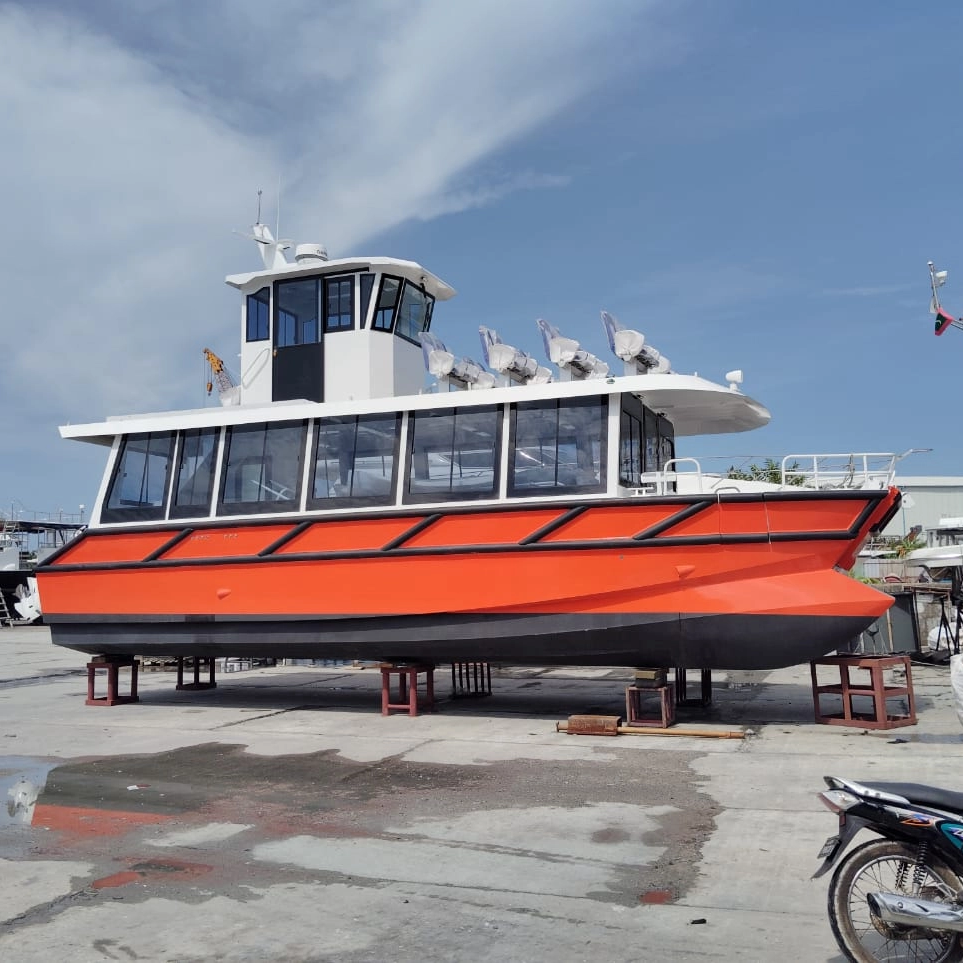
Sometimes, maximizing your passenger volume is the only way to meet intense seasonal demand.
Scaling up fundamentally changes the revenue math. Selling those 10 extra tickets during peak tourist season exponentially offsets the higher upfront acquisition cost. Consider a fifty-dollar ticket. Ten extra seats generate an additional five hundred dollars per trip. If you run four trips a day, that equals two thousand dollars in extra daily revenue. Over a busy summer season, this surplus easily pays for the larger engines and extra crew wages.
A 40 passenger ferry boat typically provides a superior onboard flow. The expanded physical footprint comfortably accommodates enclosed, climate-controlled cabins. You can install larger, ADA-compliant restrooms. Operators frequently add a small concession area. Selling snacks and beverages drives highly profitable secondary revenue streams. Passengers appreciate the extra room to stretch their legs.
High-volume seasonal tourist routes, such as whale watching or offshore island hopping.
Established municipal transit routes experiencing highly predictable commuter surges.
Dinner cruises demanding extra deck space for catering services and live entertainment.
If your market guarantees full boats in the summer, the larger vessel becomes an exceptional asset. It captures revenue you would otherwise leave waiting on the dock.
Choosing the right hull design becomes paramount as your passenger capacity increases.
Operators evaluating 40-passenger capacities frequently transition away from traditional monohulls. They heavily prefer a catamaran passenger boat for its unmatched stability. Two hulls distribute the payload weight effectively across a wider stance. This minimizes uncomfortable roll and actively prevents passenger seasickness. Twin hulls create a natural tunnel underneath. This tunnel traps air and cushions the ride over choppy waters. A stable platform generates better customer reviews and drives repeat business.
Dual-hull designs provide a significantly wider beam. This allows for incredibly comfortable 40-passenger seating arrangements. You gain valuable square footage without making the vessel overly long. It keeps the boat highly maneuverable while feeling incredibly spacious inside. Passengers can walk around safely without disrupting the vessel's running trim.
Catamarans excel at reducing hydrodynamic drag. The narrow individual hulls slice through wave resistance highly efficiently. This distinct physical advantage lowers your fuel consumption per passenger mile. Compared to a bulky, heavy monohull of identical capacity, the twin-hull setup saves you serious money at the fuel dock. It also produces a much smaller wake, which satisfies local speed restrictions.
Operators must carefully analyze the immediate and ongoing costs. You cannot base a major procurement decision on theoretical ticket revenue alone.
Base purchase prices differ significantly between 30 and 40 passenger builds. The larger boat requires a heavier hull structure. You must install substantially larger marine engines to move the heavier payload at identical cruising speeds. This drives up the initial capital requirement. You also pay more for the expanded electrical systems and plumbing.
Do not view marine diesel as a flat monthly expense. You should frame it strictly as a burn rate per filled seat. A larger boat constantly burning more fuel is only profitable if those extra 10 seats are occupied. Running a half-empty 40-passenger boat destroys your profit margin faster than running a full 30-passenger boat.
Larger capacities drastically change your maintenance logistics. Wider beams, especially on catamarans, restrict your routine service options. You may face a very limited number of available boatyards capable of hauling and servicing the vessel. Travel lifts charge by the foot and by the beam width. You must factor these higher drydocking fees into your annual operating budget.
Capacity Expense Comparison Chart
Expense Category | 30-Passenger Vessel | 40-Passenger Vessel |
|---|---|---|
Initial Purchase Price | Moderate capital requirement | High (Requires larger engines and hull) |
Fuel Burn Rate | Lower baseline daily consumption | Higher baseline; requires high occupancy |
Drydocking Logistics | Widely accommodated at most marinas | Limited to specialized, wider boatyards |
Crew Payroll | Standard single-captain requirements | Often mandates extra certified deckhands |
Follow a systematic approach before signing any purchase contract. Avoid making emotional decisions.
Calculate your precise average utilization rate. Review your past ticketing records carefully. If your existing vessels rarely exceed 80% capacity on a 30-passenger run, upgrading to 40 is an unnecessary financial risk. You must prove the demand exists before buying the larger supply. Look closely at your off-season numbers to ensure you can survive the slower months.
Perform a thorough, physical audit of your operating environment. Do not assume a larger boat will automatically fit your current slips.
Measure all dock lengths and slip widths at your destination ports.
Verify exact water depths during extreme low tide conditions.
Check local wake restrictions that might limit larger, heavier hulls.
Assess the prevalent crosswinds at your primary docking facility.
You must also consider local parking infrastructure. A boat carrying 40 passengers requires adequate parking spaces at the marina. Do not overlook shoreside logistics when upgrading your fleet size.
Engage directly with your builder's engineering team. Request a route-specific payload and compliance analysis. You must complete this step before requesting a final manufacturing quote. They will ensure the vessel matches your specific operational reality perfectly. They can adjust fuel tank placement, seating arrangements, and engine configurations to suit your unique waterways.
Choosing between a 30 vs 40 passenger ferry boat ultimately requires intense operational balance. You must carefully weigh strict regulatory thresholds against your reliable seasonal demand. A smaller vessel actively protects your margins during slow, off-peak months. It keeps your daily overhead manageable. A larger vessel aggressively maximizes your revenue when tourists flood the docks. It captures every available dollar during the short summer season.
Do not rush this critical procurement decision. Base your final choice on hard utilization data and local maritime laws. Contact our sales engineering team today. We will help you review your route requirements. Let us match the perfect hull design and passenger capacity to your specific commercial operations.
A: Maritime manufacturers use a standardized formula dictated by safety authorities. They assess the vessel's gross weight limit, conduct strict stability tests, and measure the usable deck area per person. The final capacity rating ensures the boat maintains buoyancy and resists rolling even if all passengers move to one side during an emergency.
A: Yes, it frequently does. Licensing depends heavily on the gross tonnage of the vessel and your specific jurisdiction. Crossing the 30-passenger threshold often pushes the vessel into a higher tonnage class. We highly advise checking local maritime laws to verify credential requirements before purchasing.
A: A catamaran generally carries a higher upfront acquisition cost due to its complex dual-hull construction. However, operators often recoup this expense quickly. The long-term return on investment comes from significant fuel savings, reduced wake impact, and superior passenger comfort, which drives positive online reviews and repeat business.


