Views: 0 Author: Site Editor Publish Time: 2026-09-15 Origin: Site
Commercial maritime viability hinges on matching vessel capacity to actual route demand and infrastructure limits. You cannot simply maximize potential ticket sales and hope for the best. Oversizing a commercial vessel leads to empty seats, burns excessive fuel, and inflates daily crew costs. Conversely, undersizing leaves peak-season revenue sitting on the dock and severely limits your operational scalability. Operators must objectively evaluate operational realities, regulatory thresholds, and financial trade-offs before laying a keel or signing a purchase agreement. Choosing among 20 to 60 passenger boats ensures maximum profitability and strict compliance. This framework helps you select the exact capacity your specific route demands, balancing upfront capital with long-term operational efficiency. We look at hull dynamics, dockage constraints, and crewing mandates. The goal is a vessel that works hard, stays full, and keeps overhead low.
Occupancy Benchmarks: A steady 70–80% occupancy rate is the primary indicator of optimal vessel size; purchasing based solely on 100% peak-season capacity degrades annual profit margins.
Non-Linear Scaling Costs: Crew requirements, maritime compliance (e.g., USCG Subchapter T or local equivalents), and insurance premiums scale non-linearly as passenger capacity increases.
Infrastructure Constraints: Dockage availability, draft limitations, and turnaround times must dictate the physical footprint of the vessel before evaluating passenger count.
Speed vs. Efficiency: High-speed requirements (e.g., 50 knots) drastically alter hull design, fuel capacity requirements (often exceeding 1,000 liters), and engine specifications, especially at the 60-passenger threshold.
Calculate baseline off-peak demand versus peak-season spikes carefully. Do not buy a vessel just for the busiest weekend of the year. You must track daily passenger counts over a full operating season. Identify your average Tuesday load versus a holiday weekend surge. Historical ticketing data provides the most accurate baseline. Look at weather-impacted days and shoulder seasons. Targeting a 70–80% average occupancy rate yields the highest operational efficiency. Empty seats cost fuel. They require crew attention without generating any revenue. A vessel running consistently at 80% capacity maximizes profit margins. It keeps overhead manageable during slower months. You avoid the trap of hauling dead weight. Consistent occupancy also improves the passenger atmosphere. A mostly full boat feels vibrant and successful. An empty cabin feels cold and uninviting. Focus your capacity planning on sustainable daily averages.
To accurately project your route demand, follow these specific steps:
Aggregate three years of historical ticketing data to identify true seasonal peaks and valleys.
Cross-reference passenger counts with historical weather data to account for rain-outs and small craft advisories.
Survey local hotel occupancy rates during shoulder seasons to gauge potential off-peak market expansion.
Calculate the exact fuel and crew cost required to run a completely empty vessel on your longest route.
Establish a break-even passenger count for every scheduled departure time.
Maritime regulatory bodies classify vessels based on passenger count, tonnage, and length. Crossing specific passenger thresholds triggers strict mandates. A jump from 49 to 50 passengers often changes everything. You suddenly need higher-tonnage licensed captains. Deckhand requirements scale up rapidly. Strict passenger-to-crew ratios dictate your daily labor overhead. Larger vessels also demand dedicated crew space. You must install complex safety stations. Life raft capacities must match the maximum passenger count. Fire suppression systems become significantly more complex. Stability testing requirements increase in rigor. These compliance factors heavily influence your daily operating expenses. You must map out local regulations before finalizing your capacity. Ignorance of these thresholds leads to massive budget overruns. Consult local marine surveyors early in the planning phase. They provide clarity on specific regional enforcement.
Passenger Capacity | Typical Licensing Requirement | Minimum Deckhands | Safety Equipment Scaling |
|---|---|---|---|
Up to 20 Passengers | OUPV or 25-Ton Master | 0 - 1 (Route dependent) | Standard Type I PFDs, basic flares |
21 to 40 Passengers | 50-Ton Master | 1 - 2 | Inflatable buoyant apparatus (IBA), fixed fire suppression |
41 to 60 Passengers | 100-Ton Master | 2 - 3+ | High-capacity life rafts, EPIRB, advanced stability letters |
Vessel length, beam, and draft directly impact route viability. Navigating shallow waters requires a minimal draft. Narrow channels restrict maximum beam width. You must physically measure your route before selecting a vessel. Identify low bridges and tidal restrictions. Commercial dock space availability dictates your physical footprint. Standard slips accommodate specific dimensions. Vessels exceeding standard dimensions face premium slip fees. A beam wider than 3.5 meters often requires end-tie dockage. This severely limits your mooring options. Shore power requirements also scale with vessel size. Larger air conditioning units demand heavier electrical connections. Always confirm infrastructure limits before evaluating passenger count. Upgrading dock facilities often costs more than the vessel itself. Ensure your chosen ports can handle your specific hull dimensions safely.
Consider the turning basin at your primary port. A long monohull might require a bow thruster just to pivot off the fuel dock against a running tide. Catamarans offer wider stances but demand double-wide slips. Measure the exact height of your pilings during a king tide. If your rub rails slip over the pilings, you risk severe hull damage. Check the shore power pedestals. Running a fully air-conditioned cabin for 60 people requires 50-amp or even 100-amp service. If your marina only offers 30-amp plugs, you will burn diesel running the generator at the dock.
A 20 passenger boat excels in agility and access. Primary use cases include private charters, eco-tours, and VIP transfers. Specialized dive operations also heavily favor this size. Operational advantages are significant and immediate. You face much lower crew requirements. You gain access to shallow or restricted waters. Initial capital expenditure remains highly manageable. Off-season storage is much easier. These vessels often fit within a 9-meter length. They typically feature a 1,500kg displacement footprint. This allows for convenient dry-stacking or trailer transport. However, revenue limitations do exist. You face a lower revenue ceiling per trip. These smaller vessels are highly sensitive to weather-related cancellations. Rough seas force them to stay in port. You must charge premium ticket prices to maintain strong margins. High-volume, low-cost ticketing models fail at this capacity.
When outfitting this size, operators often choose twin outboard engines. Outboards provide excellent maneuverability and allow you to trim up when navigating shallow reefs or sandbars. If an engine fails, you can unbolt it and hang a new one in an afternoon, keeping your route active. The deck layout usually features perimeter seating to maximize open floor space. This works perfectly for dive tanks or sightseeing where passengers want to move from port to starboard to take photos.
The 30 passenger boat serves as the mid-tier workhorse. Primary use cases involve boutique dinner cruises and specialized sightseeing. Mid-sized corporate events also utilize this category effectively. It balances an intimate passenger experience with stronger profit margins. You earn significantly more per trip compared to smaller vessels. It offers excellent layout flexibility. You can install standard commuter seating for transit routes. Alternatively, you can design luxury lounge configurations for sunset cruises. Revenue limitations do apply at this stage. This size often triggers stricter regulatory compliance tiers. Yet, it does not provide the massive revenue offset of larger vessels. You must manage your operating costs tightly. Marketing efforts must target group bookings to guarantee baseline revenue. This vessel size dominates coastal tourism markets globally.
At this capacity, you start dealing with more complex onboard systems. You need a proper marine head with a holding tank capable of handling a full day of use. Freshwater systems for sinks and deck washdowns become standard. The hull design usually shifts toward a heavier displacement or semi-displacement profile to handle the shifting weight of 30 adults walking around the deck. Inboard diesel engines paired with straight shafts or V-drives become popular here. They offer massive torque and run reliably for thousands of hours if maintained properly.
Scaling up your operation requires a 40 passenger boat. Primary use cases include scheduled ferry routes and large coastal tours. High-volume event charters rely heavily on this capacity. Operational advantages focus entirely on volume. You unlock significant revenue potential per single trip. You achieve economies of scale regarding fuel cost per passenger. The deck space allows for dedicated luggage storage. You can install multiple marine heads. Revenue limitations require careful attention. You need substantial marketing spend to fill seats. You must have established tourist foot traffic. This maintains profitable off-peak occupancy. It demands careful spatial planning. You must avoid a cramped, high-density feel if hosting luxury events. Boarding procedures take longer and require strict crowd management. Crew training must emphasize passenger flow and emergency evacuation protocols.
Catamaran hulls dominate this specific size bracket. The wide beam of a catamaran prevents the vessel from listing heavily when all 40 passengers rush to one side to look at marine life. This stability reduces seasickness and improves the overall customer experience. You also gain the ability to separate the cabin into distinct zones. You can have a climate-controlled interior cabin and an open-air upper deck. Managing 40 people requires a dedicated deckhand solely focused on passenger safety and comfort, leaving the captain to focus entirely on navigation.
High-volume transit routes demand a 60 passenger boat. Primary use cases cover commuter ferries and mass-market tourism. High-speed island transit routes depend entirely on this size. Operational advantages are clear and measurable. You achieve maximum ticket volume per run. This size is ideal for monopolizing high-traffic, established routes. Revenue limitations are severe and unforgiving. You face high initial capital expenditure. Massive fuel burn eats into daily profits. Stringent safety and crewing mandates apply strictly. Achieving top speeds fully loaded requires specialized hull designs. Hitting 50 knots demands massive fuel capacities. Tanks often exceed 1,000 to 1,200 liters. This severely impacts payload and operating margins. Engine maintenance schedules become aggressive. You must stock expensive spare parts to avoid route downtime.
At 60 passengers, you are operating a heavy commercial asset. The propulsion systems often shift to quad high-horsepower outboards or massive twin inboard diesels paired with waterjets. Waterjets eliminate exposed propellers, which is a massive safety advantage if you operate near swimmers or in debris-filled rivers. However, waterjets require precise maintenance of the impellers and wear rings. The electrical demands on a 60-passenger vessel are immense. You need heavy-duty generators to run commercial-grade air conditioning, radar arrays, and PA systems.
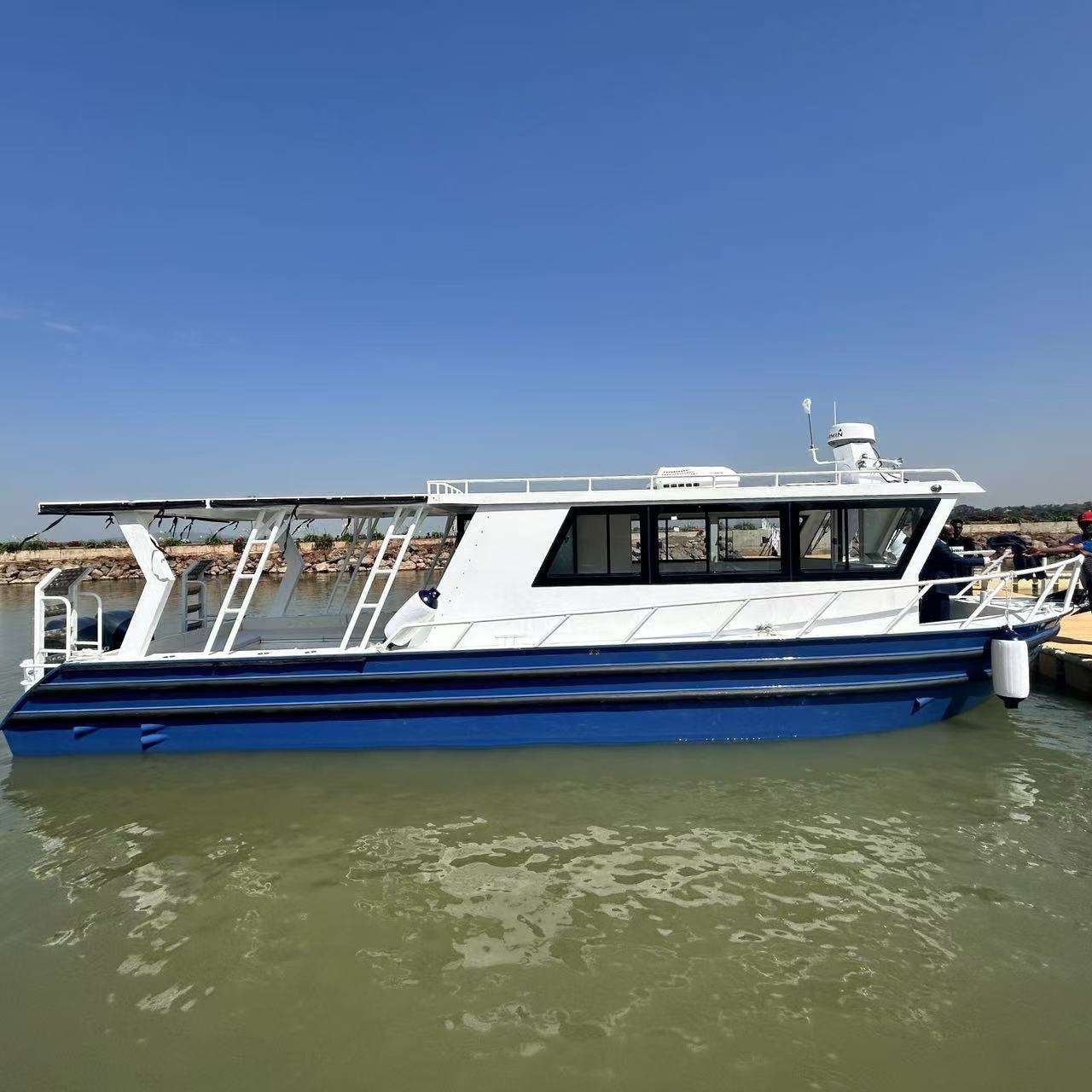
Hull design dictates your entire operational envelope. Monohulls offer excellent rough-water slicing capabilities. They handle head seas with predictable motion. Catamarans provide superior stability and massive usable deck space. They generate smaller wakes, which helps in restricted speed zones. Propulsion choices depend heavily on speed requirements. Outboards offer easy maintenance access and rapid replacement. Inboard diesels provide unmatched longevity and torque for heavy passenger loads. Waterjets excel in shallow drafts and debris-filled waters. Weight distribution remains critical across all designs. Heavy inboard engines require precise hull balancing. Passenger movement during transit shifts the center of gravity. Naval architects must calculate intact stability under full loads.
When evaluating propulsion, consider the local service network. Buying a vessel with exotic engines does you no good if the nearest certified mechanic is three states away. Stick to engine brands with a strong commercial support presence in your specific port.
Design Feature | Monohull Platform | Catamaran Platform |
|---|---|---|
Deck Space | Restricted by forward beam taper | Expansive rectangular footprint |
Stability | Prone to rolling in heavy beam seas | Highly stable, minimal roll platform |
Draft Profile | Generally deeper draft required | Often shallower draft capabilities |
Wake Generation | Larger displacement wake profile | Minimal wake, ideal for rivers |
Passenger comfort drives repeat business and positive reviews. Layout requirements depend strictly on trip duration. Target demographics dictate your seating styles. Luxury superyacht-style spacing works for high-end charters. High-density commuter seating suits short ferry runs. Climate control is mandatory for enclosed cabins in extreme weather. Marine heads must scale with passenger counts and trip lengths. Turnaround efficiency impacts your daily revenue directly. Analyze deck layouts for safe, rapid boarding. Disembarking must flow smoothly without bottlenecks. Wide aisles and multiple access gates minimize dock time. Non-skid decking prevents slip hazards during wet boarding. Clear signage directs passengers efficiently. Fast turnarounds allow for extra daily runs. Extra runs compound your daily profit margins.
To optimize your turnaround times at the dock, implement these design features:
Install port and starboard side boarding doors to accommodate different dock configurations.
Use extra-wide aisles that allow two people to pass each other comfortably.
Position luggage racks directly next to the boarding doors to prevent passengers from dragging bags through the cabin.
Utilize heavy-duty, oversized cleats to allow deckhands to secure mooring lines in seconds.
Design the helm station with clear lines of sight to the boarding gates so the captain can monitor passenger flow.
Fleet scalability requires strategic, long-term thinking. You face a distinct operational trade-off. You could operate two 30-passenger vessels. This provides redundancy and flexible scheduling. If one vessel needs maintenance, the route stays open. You can run one boat during off-peak hours to save fuel. Alternatively, you could operate a single 60-passenger vessel. This lowers aggregate crew costs significantly. You only pay one captain and one set of deckhands. However, a mechanical failure halts your entire operation. You lose all revenue until repairs finish. Two smaller vessels allow for staggered maintenance schedules. They also let you test new routes without committing massive capacity. Evaluate your risk tolerance before choosing a single massive hull.
Operating identical sister ships offers massive advantages. You only need to stock one type of oil filter, one type of impeller, and one type of spare propeller. Your crew can jump from boat A to boat B without needing to learn a new helm layout or electrical panel. Standardization across a fleet drastically reduces training time and maintenance errors.
Break down the initial purchase price against ongoing overhead. Build costs represent just the beginning of your investment. Operating expenses dictate your long-term survival. Financing terms change based on vessel classification. Luxury outfitting alters your loan structure. Intended commercial use impacts lender risk assessments. High-capacity ferries secure different terms than boutique charter boats. Always project your operating expenses over a five-year horizon. Fuel, crew, and dockage often dwarf the initial build cost. Routine maintenance consumes a predictable percentage of revenue. Unplanned breakdowns destroy cash flow. Build a robust contingency fund into your operational budget. Track every consumable item from engine oil to cleaning supplies. Accurate expense tracking prevents slow financial bleeding.
When negotiating a build contract, tie payment milestones to physical progress. Never front-load payments without seeing aluminum welded or fiberglass laid. Hire an independent marine surveyor to inspect the vessel at each milestone before releasing funds to the builder.
Speed costs money. Analyze the exponential increase in fuel consumption. Pushing larger vessels to high speeds requires massive power. Extreme power-to-weight ratios are mandatory. A fully loaded 60-passenger vessel hitting 30 to 50 knots burns fuel aggressively. Calculate your fuel cost per passenger mile. Divide your hourly fuel burn by your cruising speed. Then divide by your average passenger load. This metric reveals the true cost of high-speed transit. Sometimes, dropping speed by five knots saves thousands of dollars monthly. Passengers rarely notice a slight speed reduction. They do notice ticket price increases. Optimize your cruising RPM for maximum efficiency. Install fuel flow meters to monitor real-time consumption.
Hull fouling destroys fuel efficiency. A thin layer of marine growth on the hull increases parasitic drag exponentially. You will burn more fuel just to maintain your standard cruising speed. Schedule regular hull cleanings with commercial divers. The cost of the diver is always cheaper than the extra diesel you burn pushing a dirty hull through the water.
Commercial marine insurance premiums fluctuate wildly based on risk. Factors include passenger count, route risk, and vessel age. Replacement value heavily influences your annual premium. Maintenance schedules dictate your operational calendar. Larger commercial vessels require strict dry-docking intervals. Bottom painting and running gear inspections are mandatory. Zinc anode replacement prevents galvanic corrosion. Depreciation impacts your balance sheet annually. Aluminum hulls generally hold value better than fiberglass. They resist impact damage during heavy commercial use. Well-maintained commercial vessels retain strong resale demand in the secondary market. Keep meticulous maintenance logs to prove vessel condition. Buyers demand comprehensive service records before purchasing used commercial tonnage.
Do not skimp on preventative maintenance. Change the oil, inspect the raw water strainers, and test the bilge pumps daily. A failed float switch can sink a million-dollar asset at the dock. Create a strict daily, weekly, and monthly maintenance checklist for your crew. Hold them accountable for completing it.
Failing initial stability tests delays your operational launch. Exceeding weight limits forces costly redesigns. Missing safety equipment mandates keeps you tied to the dock. Mitigate these risks early in the process. Engage a qualified naval architect during the conceptual phase. Ensure your builder has a proven track record. They must understand local regulatory bodies intimately. Pre-construction compliance reviews save months of regulatory headaches. Schedule surveyor visits at specific build milestones. Do not wait until the vessel is finished to request inspections. Document every structural weld and material specification. Transparency with regulators builds trust and speeds up certification.
If you plan to modify an existing vessel to carry more passengers, proceed with extreme caution. Adding a second deck or extending the hull alters the center of gravity. You will have to undergo a completely new inclining experiment to prove stability. This process is expensive and often reveals that the vessel cannot safely carry the desired passenger load.
A shortage of licensed captains limits your operational days. Trained deckhands are equally scarce in many regions. This hurts operations as passenger-to-crew ratio requirements increase. Mitigate this by building competitive compensation models. Offer predictable schedules to reduce burnout. Partner with local maritime academies for recruitment. Create an internal pipeline for deckhands to earn their captain's license. Retention is always cheaper than constant recruitment. Provide high-quality uniforms and comfortable crew rest areas. Respect their sea time and mandatory rest periods. A loyal crew treats your vessel like their own. High turnover leads to equipment abuse and poor passenger experiences.
Implement a rigorous safety training program. Run man-overboard drills, fire drills, and abandon-ship drills monthly. Your crew must react to emergencies purely on muscle memory. Passengers panic during emergencies; your crew must remain calm and authoritative.
Seasonal operations face severe cash flow droughts. Storing large vessels incurs significant holding costs. Winterizing systems requires specialized labor and materials. Mitigate downtime by securing off-season commercial contracts. Consider industrial crew transfers or light freight operations. If dry-docking is necessary, schedule major refits during this period. Shrink-wrapping and secure storage protect your asset from harsh weather. Proper layup procedures prevent costly spring commissioning surprises. Flush all raw water systems with antifreeze. Remove soft goods to prevent mold growth. Disconnect and maintain battery banks. Treat fuel tanks with biocides to prevent algae growth. A disciplined layup routine ensures a flawless spring launch.
Use the off-season to overhaul your marketing strategy and ticketing software. Update your website, negotiate new contracts with local tour operators, and pre-sell tickets for the upcoming season at a discount to generate winter cash flow.
To maximize your commercial maritime investment, take the following actions:
Conduct a rigorous route analysis to determine your true average passenger load before selecting a hull size.
Consult with local maritime authorities to map out exact crewing and safety mandates for your target capacity.
Measure your intended dock spaces and route depths to ensure the physical dimensions of the vessel fit your infrastructure.
Calculate your fuel cost per passenger mile based on realistic cruising speeds, not maximum theoretical knots.
Secure specialized commercial marine insurance quotes early to accurately project your annual operating expenses.
A: Regulatory bodies classify vessels based on passenger count, gross tonnage, and overall length. Crossing specific numbers, such as moving from 49 to 50 passengers, triggers stricter mandates for captain licensing, crew ratios, and mandatory safety equipment.
A: As passenger capacity increases, maritime laws mandate higher passenger-to-crew ratios. Larger vessels require higher-tonnage licensed captains and additional trained deckhands to manage crowd control and execute emergency evacuation procedures.
A: Catamarans generally provide a wider, more stable platform and expansive deck space, making them ideal for 40 passengers. They minimize roll in beam seas and generate smaller wakes, though monohulls may perform better in heavy head seas.
A: Fuel consumption varies heavily by engine and hull design. However, pushing a fully loaded 60-passenger vessel to speeds of 30 to 50 knots requires massive power, often burning hundreds of liters per hour and requiring tanks exceeding 1,000 liters.
A: It depends on the specific hull design, stability certification, and local maritime regulations. While agile, smaller 20-passenger boats are generally more sensitive to weather and rough seas, making them better suited for protected coastal or inland waters.
A: Track daily passenger counts across a full season, including off-peak and shoulder months. Aim for a vessel size that allows you to maintain a steady 70–80% average occupancy rate, rather than sizing purely for peak holiday surges.


