Views: 0 Author: Site Editor Publish Time: 2026-09-01 Origin: Site
Selecting the right capacity for a commercial vessel directly dictates operational profitability. Empty seats drain fuel budgets rapidly, while insufficient capacity leaves peak-season revenue sitting on the dock. Operators face the constant challenge of balancing seasonal demand spikes with baseline off-peak utilization. You also have to navigate strict maritime regulations and crew-to-passenger ratio costs. This guide provides a technical and commercial framework for evaluating capacity tiers. We will explore regulatory thresholds, hull designs, and propulsion configurations. You will learn how to select the optimal passenger boat for your specific tourism operation, ensuring maximum seat utilization and regulatory compliance across all seasons.
Capacity Dictates Compliance: Crossing specific passenger thresholds (e.g., 6, 49, 149 passengers) triggers exponentially stricter regulatory inspections, safety equipment mandates, and crew licensing requirements.
Utilization Over Maximum Volume: A highly utilized mid-size vessel often yields a better annual ROI than a large vessel that only reaches maximum capacity during a few peak holiday weeks.
Design Must Match the Route: The choice between a standard hull and a custom passenger boat depends entirely on route specifics, including draft restrictions, wake regulations, turnaround times, and the primary tourism use case.
Total Operating Expenses: Larger capacities require exponentially higher insurance premiums, specialized docking infrastructure, increased propulsion demands, and higher maintenance overhead.
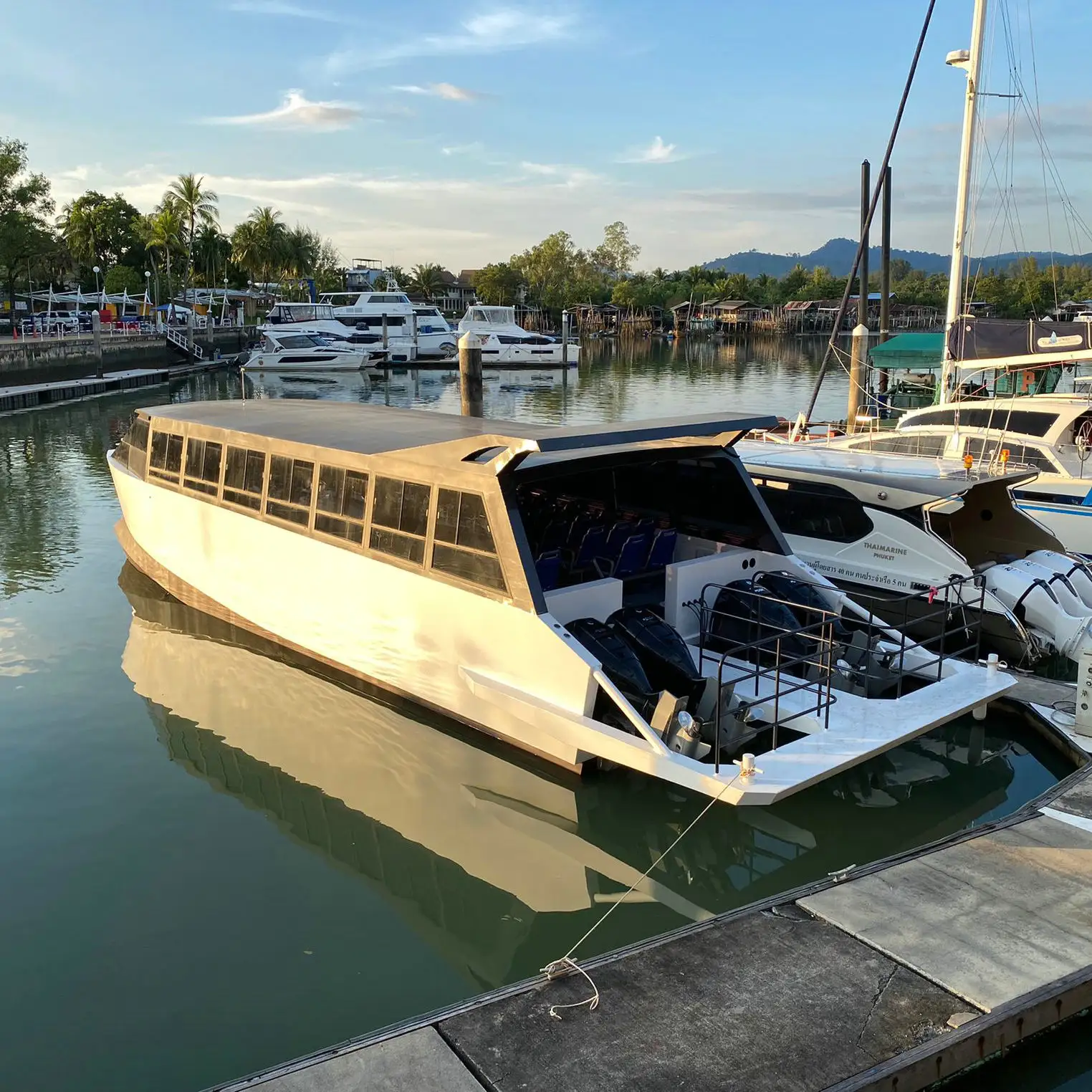
Financial baselines for tourism vessels rely on a ruthless metric. You must evaluate the cost per available seat mile against revenue per available passenger. A massive boat looks incredible on paper during a holiday weekend. However, running a half-empty vessel during the shoulder season destroys profit margins. Fuel consumption remains relatively constant whether you carry ten people or fifty. The engines still push the same heavy hull through the water. Therefore, operators must define success not by maximum volume, but by consistent seat utilization. Every empty seat represents burned fuel that generates zero revenue. Maximizing your load factor on average days is the true path to commercial success.
To accurately project this, you have to break down your daily operating costs. You calculate the daily fuel burn, crew wages, insurance apportionment, and maintenance reserves. Divide that total by the number of trips you run per day. That gives you the cost per trip. Then, divide the cost per trip by your ticket price. This reveals your break-even passenger count. If your break-even count is 25 passengers, and you buy a 100-passenger vessel, you are taking on massive risk. A smaller vessel with lower daily operating costs might have a break-even point of just 12 passengers, making it far easier to turn a profit on a rainy Tuesday.
Analyzing historical or projected route data is your first step. You need to determine average daily ridership versus extreme seasonal peaks. Buying a boat solely for peak capacity is a common financial trap. A massive vessel might sell out during summer festivals. Yet, it will bleed money during quiet autumn weekdays. Smart operators calculate their break-even passenger load based on average days. They size their fleet to exceed this break-even point on a standard weekday, rather than a holiday Saturday.
Consider the standard deviation in your ridership data. If you operate in a highly seasonal market, your summer peaks might be five times higher than your spring averages. In these scenarios, a single large vessel becomes a liability. You are paying to push empty fiberglass and aluminum through the water for eight months of the year. Instead, you should look at the median passenger count over a 180-day operating season. Design your primary vessel around that median number. You can always capture peak demand by running more frequent trips or adding a second, smaller vessel to the fleet during rush periods.
Vessel capacity heavily impacts your daily route scheduling. High-demand routes certainly benefit from larger vessels. This only holds true if boarding and disembarking times do not disrupt the timetable. A massive boat takes longer to load. It takes longer to tie up. It takes longer to clear the dock. If a high-capacity vessel slows down your turnaround time, you might complete fewer trips per day. Sometimes, a smaller, faster boat completing more daily circuits generates higher daily revenue.
You must measure the exact time it takes to cycle a full load of passengers across your specific boarding ramps. Think about the physical logistics. Fifty people walking down a narrow wooden dock, scanning tickets, and stepping over a gunwale takes time. If you operate a tourism passenger boat on a tight one-hour schedule, a 15-minute turnaround kills your efficiency. You lose a quarter of your operating window just moving people on and off the deck. Smaller vessels with wide boarding doors and flush decks allow for rapid passenger exchange. This keeps the engines running and the boat moving, which is the only time it actually generates revenue.
Maritime labor laws dictate crew sizes based strictly on passenger counts. Crossing a regulatory threshold often mandates hiring an additional deckhand. Adding a second or third crew member significantly impacts daily operating margins. You must pay wages, benefits, and insurance for each crew member regardless of ticket sales. If upgrading from a 49-passenger to a 60-passenger vessel requires another deckhand, the revenue from those 11 extra seats must cover the new labor cost. If it does not, your larger boat is actually less profitable per trip.
Crew requirements also scale with the physical layout of the vessel. A multi-deck boat often requires a crew member stationed on each level for safety and crowd control. A single-deck open layout might allow the captain and one deckhand to maintain full visual control of all passengers. When you evaluate capacity, you must simultaneously evaluate the deck plan. A poorly designed 50-passenger boat might require three crew members, while a well-designed 49-passenger boat requires only two. Over a 200-day operating season, the salary of that third crew member represents a massive hit to your bottom line.
Capacity directly influences the legal classification of your vessel. Maritime authorities do not treat all boats equally. The number of people you carry dictates structural fire protection rules. It dictates the number of life rafts required. It also determines the specific licensing your captain must hold. Ignorance of these thresholds leads to massive compliance fines or grounded vessels. You must design your business model around these strict legal boundaries.
When you cross specific passenger counts, the physical construction of the boat must change. Authorities mandate specific hull thicknesses, collision bulkheads, and bilge pumping capacities. You cannot simply buy a recreational yacht and put 20 paying tourists on it. Commercial vessels undergo rigorous plan reviews before the first piece of aluminum is even cut. The naval architect must submit detailed drawings proving the vessel can survive flooding in specific compartments without sinking. These engineering requirements scale aggressively as passenger capacity increases.
The most critical regulatory divide happens at the six-passenger mark. Vessels carrying six or fewer paying guests often operate as Uninspected Passenger Vessels. These require minimal commercial safety gear. The captain usually needs a basic license. However, carrying seven or more passengers transitions the boat into an Inspected Passenger Vessel category. This triggers rigorous structural requirements. You will need approved stability letters. You must install commercial-grade fire suppression systems. The hull construction must meet strict maritime standards.
The jump in compliance costs from six to seven passengers is astronomical. An inspected vessel requires annual visits from marine inspectors. They will check every fire extinguisher, test the bilge alarms, and review your crew training logs. If the boat fails any part of this inspection, you cannot legally operate. Many operators choose to run multiple six-passenger boats rather than deal with the regulatory burden of a single 15-passenger inspected vessel. You must weigh the revenue potential of those extra seats against the heavy administrative and structural costs of compliance.
Engineers determine safe limits through rigorous stability tests. They issue capacity plates based on these results. These plates typically sit at the helm or transom. They state the absolute maximum number of people allowed onboard. Recently, authorities updated the assumed average weight per passenger. People are heavier now than they were decades ago. This regulatory update means older boats often see their legal capacity reduced upon reinspection.
During an inclining experiment, naval architects place heavy weights on the deck and measure how far the boat leans. This proves the vessel will not capsize if all passengers rush to one side to look at a whale. If you want to carry 50 people, the boat must possess enough inherent buoyancy and beam width to counteract that massive weight shift. Furthermore, gross tonnage limits intersect with passenger capacity. Larger, heavier vessels require captains with higher-tonnage master licenses. These highly qualified captains command significantly higher salaries, which further increases your daily operating expenses.
Small vessels serve specific, high-margin niches. They are ideal for luxury resort transfers. Operators use them for private charters and boutique water taxis. Eco-tours also favor small boats to navigate shallow, protected waters. The primary advantage is a lower regulatory burden. You often need only one captain and minimal crew. The margin per ticket is usually high.
These boats typically utilize outboard engines, which simplifies maintenance. If an engine fails, you can unbolt it and hang a new one on the transom in a single afternoon. This keeps downtime to an absolute minimum. However, the main drawback is limited scalability. When a massive cruise ship docks in your town, a 20-passenger boat cannot capture the sudden surge in demand. You are capped at a low daily revenue ceiling, regardless of how many tourists want to buy a ticket.
This tier represents the sweet spot for many operators. These boats handle standard coastal tours and scheduled island shuttles. A 48-passenger vessel often requires just a captain and one deckhand. This keeps labor costs manageable while providing substantial revenue potential. It balances volume with efficiency. You can fill a 40-passenger boat relatively easily on a standard summer day.
Mid-size vessels often feature twin inboard diesels or high-thrust commercial outboards. They have enough deck space for a single restroom and perhaps a small beverage counter. This size remains the backbone of consistent daily tourism routes. It offers the best balance of operational agility and revenue generation. You generate enough cash flow to cover commercial insurance and dockage, while maintaining a low enough break-even point to survive the shoulder seasons.
High-volume municipal transit and major landmark tours require serious capacity. Dinner cruises also fall into this category. Operating a 75 passenger boat maximizes revenue during the peak season. You can move large groups efficiently. You can accommodate entire bus tours in a single trip.
However, the drawbacks are significant. You need deep-draft docking facilities. You must implement complex safety management systems. You will likely need a multi-person crew, including dedicated deckhands and hospitality staff. Most importantly, you need a massive off-peak marketing budget. Filling 75 seats in November requires aggressive promotion and discounted group rates. The maintenance on a vessel this size requires specialized shipyards, as standard marina travelifts cannot handle the tonnage.
Capacity Tier | Typical Passenger Count | Ideal Tourism Use Case | Crew Requirement | Regulatory Burden |
|---|---|---|---|---|
Small | Up to 20 | Eco-tours, Private Charters, Resort Transfers | Low (1-2 members) | Moderate |
Mid-Size | 20 to 50 | Coastal Tours, Island Shuttles, Water Taxis | Medium (2-3 members) | High |
Large | 50 to 75+ | Dinner Cruises, Landmark Tours, Municipal Transit | High (3+ members) | Very High |
Physical boat characteristics must match your specific business model. A sightseeing passenger boat often features an open-air design. This provides 360-degree visibility for eco-tours and wildlife watching. Passengers want to feel the breeze and take unobstructed photos. Open boats are lighter, cheaper to build, and easier to maintain. You do not have to worry about air conditioning failures or fogged windows.
Conversely, commuter routes require climate-controlled cabins. Enclosed spaces allow for year-round operation. They protect passengers from rain, wind, and extreme heat. You must decide if your route prioritizes scenic immersion or passenger comfort. Enclosed cabins require heavy marine HVAC systems, which draw massive amounts of electrical power. This usually mandates a dedicated onboard diesel generator, adding another engine to your maintenance schedule. Hybrid designs with retractable roofs offer flexibility but increase mechanical complexity and build costs.
Hull shape dictates performance and passenger comfort. Planing monohulls work best for fast, point-to-point transit. They cut through chop and deliver passengers quickly. However, they tend to roll at slow speeds, which can cause seasickness during a slow-moving sightseeing tour.
Catamarans offer entirely different advantages. They provide superior lateral stability. This prevents the boat from rolling heavily when passengers move to one side to view wildlife. Catamarans also feature wider beams and shallower drafts. A wider beam allows for multiple access points. This is critical for fast turnaround times on high-capacity vessels. Faster boarding means more trips per day. The shallow draft allows catamarans to pull up to remote beaches or navigate tidal estuaries that would ground a deep-V monohull.
Passenger weight dictates your horsepower requirements. A fully loaded vessel handles very differently than an empty one. Operators must scale their propulsion systems accordingly. Seventy-five adult passengers add over 13,000 pounds of deadweight to the hull. If your engines are undersized, the boat will struggle to get on plane, burning excessive fuel and running behind schedule.
Some utilize quad high-horsepower outboards for a fully loaded 45-passenger vessel. Outboards offer easy maintenance and quick replacement. They also keep the noise and vibration outside the passenger cabin. Others prefer traditional inboard diesels. Diesels provide immense torque for heavy loads and boast long lifespans. They swing larger propellers, which offer better low-speed maneuverability around tight docks. Your choice depends on local mechanic availability, daily running hours, and the structural weight of the vessel.
Trip duration dictates onboard amenities. A ten-minute water taxi does not need a bathroom. A three-hour coastal cruise absolutely requires onboard restrooms and galley spaces. You must also consider ADA-compliant boarding ramps and wheelchair tie-downs. Remember that every bathroom or snack bar eats into your total passenger capacity. A large head compartment might take up the deck space of four paying seats.
Furthermore, high-capacity vessels suffer intense wear and tear. You must specify commercial-grade, low-maintenance materials. Avoid teak decks and delicate fabrics. Aluminum diamond-plate decks, heavy-duty vinyl seating, and robust rubber rub rails minimize downtime. When a boat runs ten hours a day, seven days a week, you do not have time for cosmetic repairs. The vessel must withstand constant foot traffic, spilled drinks, and heavy impacts against concrete seawalls.
Procurement strategy heavily influences your overall financial risk. Sometimes, off-the-shelf designs make the most financial sense. Stock hulls come with proven sea-keeping abilities. They have established capacity ratings. Most importantly, they offer immediate or short-term availability. If you need to launch a new route by next summer, a standard build is your safest bet.
The engineering is already done, saving you significant upfront design fees. You also benefit from the real-world performance data of previous buyers. You know exactly how much fuel the boat burns at cruising speed. You know exactly how it handles in a following sea. Standard builds also hold their resale value well, as they appeal to a broad market of commercial operators when you decide to upgrade your fleet.
Standard boats do not fit every operational profile. Sometimes you must commission a custom passenger boat. Strict draft limitations in shallow bays require bespoke hull designs. Unique boarding infrastructure at your specific dock might demand custom side-doors that align perfectly with your ramps. You might also have specific hybrid or electric propulsion requirements to meet local environmental laws.
Custom builds involve extended lead times. You have to pay naval architects to draft new plans and submit them for regulatory approval. However, a boat designed perfectly for your exact route delivers massive long-term operational efficiencies. If a custom hull design allows you to carry five more passengers per trip while burning ten percent less fuel, the upfront engineering costs pay for themselves within the first few seasons of operation.
Capacity miscalculations lead to severe operational pitfalls. Buying one massive boat creates a single point of failure. If that boat hits a submerged log and bends a propeller shaft, your entire business shuts down while it sits in the shipyard. You lose all your daily revenue, but your fixed costs remain.
Consider the benefits of fleet diversification. Operating two 30-passenger boats is often safer than running one 60-passenger boat. Two boats maintain schedule flexibility. If one vessel suffers a mechanical failure, you can still operate the route with the other. During the slow season, you can pull one boat out of the water completely. This slashes your daily running costs, reduces engine hours, and allows you to perform deep maintenance without interrupting your baseline revenue stream.
Larger vessels hide significant secondary costs. A massive boat requires specialized docking infrastructure. Municipal slip sizes often restrict vessels over a certain beam or length. You must secure commercial dock space before buying the boat. Finding a slip that can accommodate a 25-foot beam catamaran is incredibly difficult in crowded coastal cities.
Furthermore, maintenance becomes vastly more complicated. Heavy-lift travelifts are not available at every marina. You might have to travel hundreds of miles to find a suitable dry-dock facility capable of lifting a 75-passenger vessel. These logistical hurdles add immense overhead to your annual operating budget. You must factor in the fuel costs and crew wages just to transit the boat to the shipyard for its mandatory annual hull inspections.
Calculate your average daily ridership using historical local tourism data to establish a realistic break-even point.
Identify the strict regulatory ceilings in your jurisdiction before finalizing a passenger count to avoid unexpected compliance costs.
Evaluate your dock infrastructure to ensure it can handle the beam, draft, and boarding height of your chosen vessel.
Determine your propulsion needs based on the fully loaded deadweight of the vessel, not the empty hull weight.
Consult a commercial marine broker to conduct a thorough route feasibility study before signing a build contract.
A: Naval architects calculate capacity through rigorous stability tests and inclining experiments. They assess the vessel's displacement, deck space, and buoyancy. Regulatory bodies then apply an assumed average weight per passenger. The final legal capacity ensures the vessel will not capsize even if all passengers move to one side during an emergency.
A: The official capacity rating is displayed on a permanent capacity plate. This plate is typically mounted near the helm station, in clear view of the captain. It may also be located on the transom. It explicitly states the maximum number of passengers and total weight allowed onboard.
A: The most profitable size depends entirely on average route utilization. Generally, mid-size vessels carrying 20 to 50 passengers offer the best balance. They keep crew requirements low while providing enough seats to generate strong daily revenue without running empty during the off-season.
A: Yes. Operating a large commercial vessel requires a specific Master’s license issued by maritime authorities. The required license tier depends on the gross tonnage of the vessel. A boat carrying 75 people is heavy and complex, mandating a highly credentialed and experienced captain.
A: Maritime regulations mandate specific crew-to-passenger ratios for safety and evacuation purposes. Crossing certain passenger thresholds legally requires adding deckhands. For example, moving from 49 to 50 passengers often triggers the mandatory hiring of an additional crew member, which directly increases your daily labor costs.
A: Increasing legal capacity is difficult but sometimes possible. A shipyard must perform structural modifications to increase stability and deck space. Naval architects must conduct new stability tests. Finally, maritime authorities must inspect the vessel and issue a new Certificate of Inspection before the capacity officially increases.
A: Small water taxis carrying six or fewer passengers often operate as uninspected vessels with minimal regulatory oversight. Large sightseeing boats are strictly inspected. They require commercial-grade fire suppression, extensive life-saving equipment, structural fire protection, and mandatory annual safety inspections by maritime authorities.


