Views: 0 Author: Site Editor Publish Time: 2026-02-04 Origin: Site
Patrol Boats are often seen in moments when time, precision, and reliability matter most. A quiet night patrol inside a busy commercial port, a rapid-response rescue call just miles offshore, or a law enforcement interception in shallow coastal waters all demand vessels that can perform without hesitation. These boats are not built for leisure or comfort-first cruising. They exist to serve missions where speed, maneuverability, and dependable performance define success. As a professional aluminium boat manufacturer, Poseidon Boat designs and builds patrol boats specifically for these demanding scenarios, supporting security, rescue, monitoring, and enforcement operations across diverse marine environments.
Understanding what patrol boats are used for starts with recognizing how they differ from ordinary working boats. They are mission-focused platforms designed to operate frequently, often under pressure, and in conditions where reliability is non-negotiable. For port authorities, marine police, research teams, and rescue organizations, patrol boats are not optional assets but essential operational tools.
A patrol boat is a small to medium-sized, high-performance vessel designed primarily for nearshore, inland waterway, and port-area operations. Unlike large offshore ships, patrol boats are optimized for agility, fast acceleration, and frequent maneuvering. Their role typically includes security patrols, search and rescue missions, law enforcement operations, and support for scientific or environmental monitoring activities. What defines a patrol boat is not only its size, but its ability to respond quickly and operate reliably during repeated daily missions.
Patrol boats are commonly deployed in three main environments: coastal waters, ports and harbors, and rivers or inland waterways. Each environment places different demands on the vessel. Coastal patrols require good seakeeping and the ability to handle changing wave conditions. Port operations demand excellent low-speed control, visibility, and durability due to frequent docking and close-quarters maneuvering. River and inland patrols often involve shallow water, narrow passages, and obstacles, making hull design and propulsion choices especially important. A well-designed patrol boat balances these factors to match its intended operating area.
Different missions place different priorities on vessel design. Understanding these use cases helps operators identify what really matters when evaluating a patrol boat.
Security patrols in ports, coastal infrastructure zones, and restricted waterways require vessels capable of long operating hours with consistent stability. Patrol boats used for surveillance must offer good visibility from the helm, reliable communication systems, and the ability to operate effectively at night. Stable platforms reduce crew fatigue during extended patrols, while robust construction ensures the boat can withstand frequent docking and close-range inspections.
Search and rescue missions demand rapid response above all else. Patrol boats used in rescue scenarios must reach the incident site quickly and remain stable while recovering people from the water. Open working decks, clear access points, and sufficient space for rescue equipment are essential. Reliability is critical, as mechanical failure during a rescue mission is simply not acceptable.
In nearshore scientific research, patrol boats often serve as mobile platforms for sampling, observation, and equipment deployment. These missions prioritize low-speed stability, predictable handling, and flexible deck layouts. Researchers may need to install temporary equipment, operate sensors, or collect samples, making adaptability and steady performance more important than top speed.
Hydrology and water quality monitoring projects frequently operate in rivers, reservoirs, and coastal zones. Patrol boats in this role must support precise low-speed control and accommodate sensors, sampling systems, and data transmission equipment. Corrosion resistance and ease of maintenance become particularly important due to prolonged exposure to water and environmental contaminants.
Law enforcement patrol boats support boarding operations, interception tasks, and presence patrols. These missions require high maneuverability, rapid acceleration, and practical deck layouts that allow officers to move safely and efficiently. Storage for equipment, safe boarding access, and reliable propulsion all contribute directly to operational effectiveness.
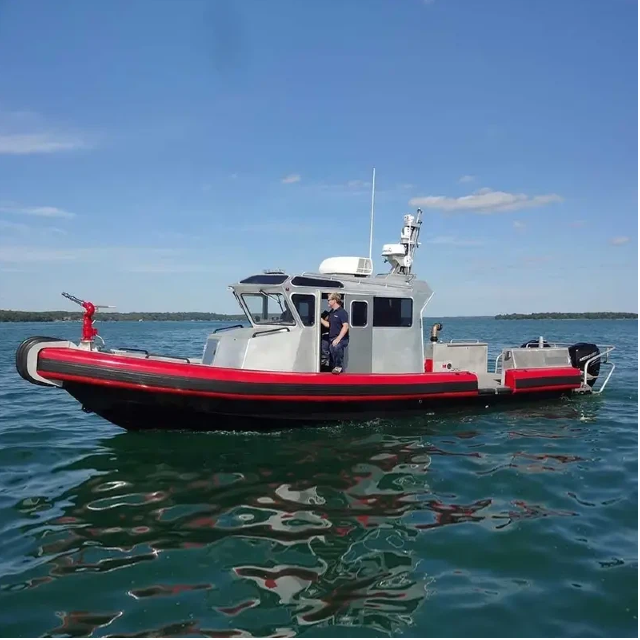
Not every boat capable of floating qualifies as a patrol boat. Certain features transform a vessel into a dependable operational asset.
The hull design of a patrol boat determines how it handles waves, impacts, and repeated use. A stable hull improves crew comfort and safety, particularly during long patrols or rough conditions. Good seakeeping allows the boat to maintain speed and control without excessive slamming, which reduces fatigue and structural stress over time.
Patrol boats commonly use outboard engines, inboard systems, or waterjet propulsion. Outboard engines are valued for ease of maintenance and high power-to-weight ratios, making them suitable for fast-response missions. Inboard systems may offer better protection and weight distribution for certain operations. Waterjets are often preferred in shallow or debris-filled waters where propeller damage is a concern. Choosing the right propulsion system depends on water depth, operating environment, and mission profile.
A patrol boat’s deck layout directly affects how efficiently the crew can perform tasks. Clear movement paths, secure storage, safe boarding areas, and well-placed safety rails all contribute to smoother operations. Good workflow design reduces response time during critical moments and improves overall safety during daily use.
Modern patrol boats rely on integrated navigation and communication systems to coordinate operations effectively. Reliable radar, GPS navigation, communication equipment, and lighting systems support both routine patrols and emergency missions. These systems are not optional additions but core components of a professional patrol vessel.
Selecting the right patrol boat size is less about maximizing specifications and more about matching operational needs.
Operators typically begin by assessing where the boat will operate most often. Open coastal waters, sheltered harbors, and inland rivers all impose different constraints. The operating environment influences hull form, freeboard, propulsion choice, and overall vessel size. A patrol boat optimized for one environment may be less effective in another.
Every patrol boat involves trade-offs. Higher speed can reduce range, while greater payload capacity may affect acceleration. Endurance determines how long the vessel can remain on station without refueling. Successful patrol boat design finds the right balance between these factors to support real-world missions rather than theoretical performance targets.
Crew comfort is often underestimated but directly affects operational capability. Adequate seating, weather protection, and ergonomic helm layouts allow crews to remain effective during long shifts. For patrol boats used in colder climates or extended missions, enclosed cabins can significantly improve safety and performance.
Mission Type | Typical Environment | Priority Factors | Suggested Layout | Useful Add-ons |
Security Patrol | Ports, coastal zones | Stability, endurance | Enclosed or semi-cabin | Searchlights, surveillance systems |
Search and Rescue | Coastal, nearshore | Speed, deck access | Open deck | Rescue rails, stretcher space |
Scientific Research | Nearshore waters | Stability, flexibility | Open working deck | Equipment mounts, power supply |
Water Monitoring | Rivers, reservoirs | Low-speed control | Open or hybrid | Sampling racks, sensor mounts |
Law Enforcement | Coastal, inland | Maneuverability | Reinforced deck layout | Boarding aids, secure storage |
Many agencies and operators gravitate toward aluminium patrol boats due to their practical advantages. Aluminium construction offers a strong balance between weight and durability, supporting higher speeds and better fuel efficiency. Its natural corrosion resistance makes it suitable for frequent use in marine environments, while its structural properties allow for easier modification and repair. These qualities make aluminium particularly attractive for fast-response and high-frequency patrol operations, setting the stage for more specialized discussions in later articles.
The true value of patrol boats lies in how well they match the mission they are built to serve. Speed, size, and specifications only matter when they align with real operational needs. For security patrols, rescue missions, research support, or environmental monitoring, the right patrol boat is one that performs reliably day after day. As a leading aluminium boat manufacturer, Poseidon Boat designs and builds patrol boats that balance speed, power, and safety, with customization options to suit specific operational requirements. To learn more about how our patrol boats can support your missions, contact us today or explore our full range of aluminium patrol vessels on our website.
What are patrol boats mainly used for?
Patrol boats are primarily used for security patrols, search and rescue operations, law enforcement tasks, and support for scientific and environmental monitoring in coastal and inland waters.
Are patrol boats suitable for rough water conditions?
Yes, professionally designed patrol boats are engineered to handle challenging conditions, with hull designs and structures optimized for stability and reliability in rough or changing waters.
Why are aluminium patrol boats widely used?
Aluminium patrol boats offer a strong combination of durability, corrosion resistance, and reduced weight, making them well suited for fast-response and high-frequency operations.
Can patrol boats be customized for specific missions?
Yes, patrol boats can be customized with different layouts, propulsion systems, and onboard equipment to match the exact needs of security, rescue, research, or monitoring missions.


