Views: 0 Author: Site Editor Publish Time: 2026-07-22 Origin: Site
For commercial fleet operators and tourism businesses, choosing between a catamaran and a monohull represents a foundational business decision. It is never just a technical preference. Hull design directly dictates your daily operational expenditures. It also defines your maximum revenue per trip and overall passenger retention. If you select the wrong architecture, you risk bleeding revenue through excessive fuel consumption. You might also suffer from low customer satisfaction levels.
Passengers hate seasickness, and operators hate wasted deck space. This guide provides an evidence-based comparison of monohull and catamaran models. We will help you align vessel architecture with route requirements, port infrastructure, and profitability targets. You will learn how to evaluate stability, capacity, and route suitability practically. Read on to discover which hull maximizes your commercial maritime investment and keeps your fleet operating profitably year after year.
Stability: Catamarans significantly reduce wave-induced rolling, minimizing passenger seasickness and expanding operable weather windows.
Capacity: The wide beam of a catamaran passenger boat offers a higher passenger-to-length ratio, allowing for more revenue-generating deck space compared to a monohull of the same length.
Operating Cost: While catamarans generally offer better fuel efficiency at specific cruising speeds due to lower hydrodynamic drag, they incur higher berthing and haul-out costs due to their wider footprint.
Decision Baseline: Monohulls remain highly effective for heavy-weather, deep-water, and narrow-infrastructure routes, whereas catamarans dominate shallow-draft, high-capacity passenger ferry operations.
Understanding the fundamental geometry of marine vessels helps you forecast long-term commercial viability. Builders engineer monohulls and catamarans using entirely different hydrodynamic principles. These differences directly impact where and how you can operate.
A monohull uses a single-hull displacement or planing design. Naval architects rely on traditional deep-v architecture built specifically for slicing through heavy chop. The heavy keel sits low in the water. It uses deep displacement to maintain steady forward momentum.
Commercial Reality: This deep-v shape requires a deeper draft. You need deeper channels to operate safely. However, standard shipyards handle monohulls easily. Mechanics can lift and dry-dock them using narrow, conventional travel lifts. This keeps your emergency haul-out costs relatively low.
A catamaran features a dual-hull design connected by a wide bridging deck. It relies on widespread lateral buoyancy rather than deep downward displacement. The two narrow demi-hulls cut through the water efficiently.
Commercial Reality: A shallower draft unlocks highly restricted coastal routes. You can navigate closer to beaches and shallow reefs. Furthermore, dual-engine redundancy drastically improves safety compliance. Regulatory bodies favor this redundancy. It provides a massive operational benefit for any commercial Passenger Boat navigating remote coastal areas.
Always measure the narrowest channel in your planned route at extreme low tide.
Consult local shipyards regarding their maximum travel-lift beam width before purchasing a multi-hull.
Evaluate local maritime regulations regarding mandatory engine redundancy for passenger transport.
Passenger comfort directly equals revenue protection. If guests feel ill during a charter, they will never return. They will also leave poor reviews, damaging your future ticket sales.
Monohulls tend to roll aggressively on a single central axis. When waves hit the side of the vessel (beam seas), standard monohulls swing like a pendulum. To combat this, you often must install expensive active stabilization systems. Fins or gyroscopes become necessary to match a multi-hull resting stability.
Conversely, catamarans possess high initial stability. Naval engineers call this "form stability." The wide footprint naturally resists lateral rolling. This drastically reduces kinetic transfer to the people onboard. Your guests remain stable, even when crossing rougher harbor wakes.
Minimizing seasickness directly protects your brand. Happy passengers buy more onboard concessions. They recommend your tour to friends. Repeat business thrives when people feel entirely comfortable. An ultra-stable Catamaran Boat keeps guests standing securely at the bar, increasing your secondary revenue streams per trip.
Catamarans excel in shallow routes. They generate much less wake energy. They require minimal water depth to float safely. However, operators must beware of the "snap roll" phenomenon. In steep, short-frequency wave conditions, a dual-hull vessel can feel unexpectedly jerky. The wide hull rapidly snaps back to a level position after a wave passes. Monohulls slice through these deep-water, short-chop waves much more predictably. They offer a softer, albeit roll-heavy, ride in the open ocean.
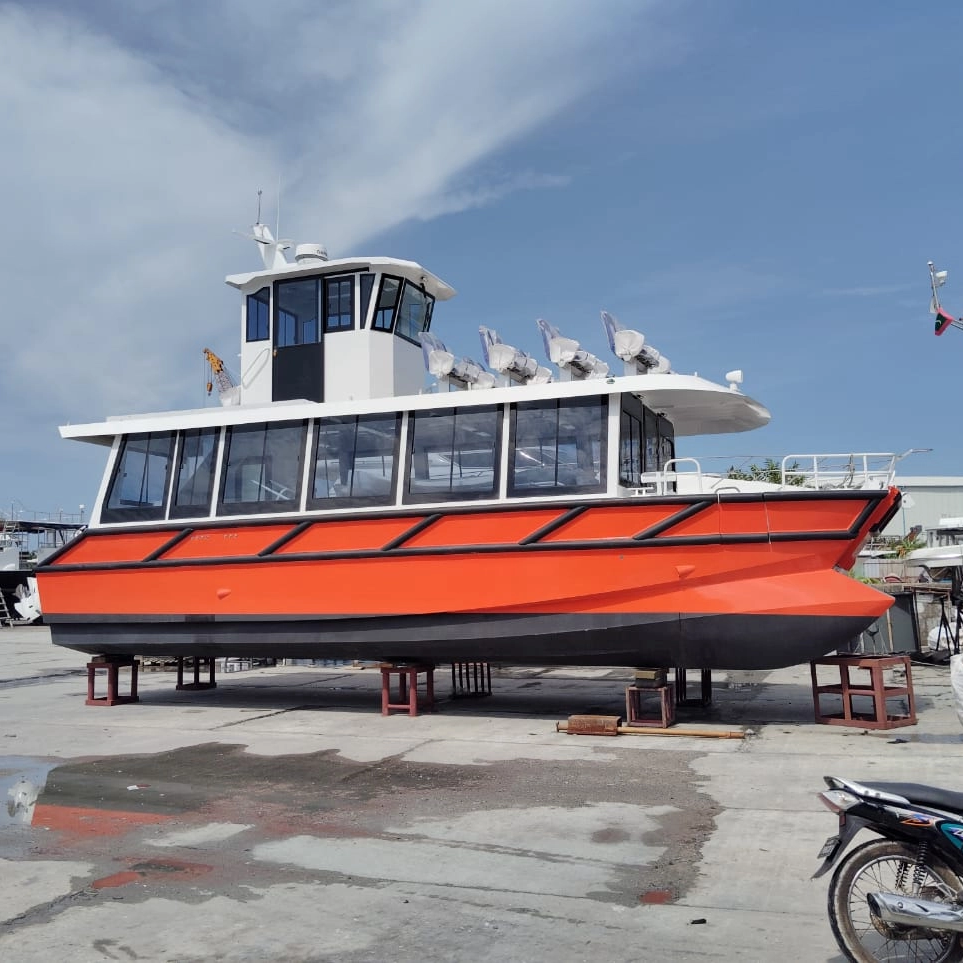
Fleet profitability often comes down to simple geometry. How many paying customers can you fit safely into a specific hull length?
Let us examine the square footage per foot of length overall (LOA). A dual-hull design typically yields 20 to 30 percent more usable deck space. It beats a similarly sized monohull easily. You receive a massive, rectangular footprint instead of a narrow, tapered triangle. This broad platform changes how you design the interior layout.
Wider beams allow for significantly wider aisles. You achieve faster boarding and disembarking at the docks. ADA-compliant accessibility becomes much simpler to implement. Wheelchairs navigate easily without bottlenecks. Fast passenger flow improves daily schedule reliability. These remain crucial performance metrics for any high-frequency Passenger Ferry Boat trying to squeeze in extra daily departures.
The rectangular deck footprint supports highly profitable additions. You can install substantial extra seating. You can build larger, fully stocked bars. You can easily partition premium VIP zones. You accomplish all this without compromising the vessel balance.
Deck Feature | Monohull Capability | Catamaran Capability |
|---|---|---|
Aisle Width | Narrow, prone to bottlenecks | Wide, easy dual-lane flow |
ADA Accessibility | Requires complex custom ramping | Highly accommodating flat decks |
Seating Layout | Tapered forward, limited rows | Uniform rectangular grid |
VIP & Bar Space | Limits overall passenger capacity | Easily integrated side-by-side |
Cramming too many seats into the tapered bow of a monohull, causing passenger claustrophobia.
Failing to utilize the massive bridge deck of a multi-hull for high-margin concession stands.
Ignoring traffic bottlenecks near the gangway during peak boarding hours.
Capital expenditure only tells half the story. Daily operational costs dictate your long-term survival in the commercial maritime industry.
Evaluate the hydrodynamic drag. Compare the wetted surface area. Catamarans typically require much less horsepower to reach cruising speeds. The twin slender hulls slice efficiently through the water. They avoid pushing a massive bow wave. This results in measurable fuel savings. High-speed craft operations benefit greatly from this low-drag profile. You spend less on diesel during long coastal transits.
Consider your routine maintenance multipliers carefully. The multi-hull premium is very real. Two hulls mean two engines. You must maintain two separate sets of running gear. You have twice the hull surface area to clean periodically. Bottom painting and antifouling costs effectively double. You also need double the zinc anodes to prevent galvanic corrosion.
The monohull advantage lies entirely in mechanical simplicity. A simpler footprint translates directly to lower routine maintenance costs. Mechanics easily access a single centralized engine room. Sourcing standard replacement parts remains straightforward and cheaper.
Calculate the hidden cost of a wide beam. Many commercial marinas charge premium rates based on maximum width. Some facilities require you to rent double slips to accommodate a wide Catamaran Passenger Boat. Over five years, these inflated docking fees severely impact your bottom line. Always negotiate slip fees before signing a shipyard build contract.
A vessel is only as good as the infrastructure supporting it. You must match your hardware to the geographic reality of your route.
Does your local port actually have wide slips? Do they own specialized wide-stance travel lifts? Dry docks must accommodate broad vessels safely. Many older shipyards strictly cater to traditional narrow ships. If your home port lacks wide-lift shipyards, simple emergency repairs become logistical nightmares. You might have to travel hundreds of miles just to pull the vessel out of the water.
Wake regulations pose another common operational challenge. Dual-hull vessels produce significantly smaller wakes at displacement speeds. This makes them ideal for ecologically sensitive areas. Strict no-wake zones favor multi-hull designs. If your route passes through protected marine sanctuaries or tight residential canals, a low-wake profile prevents regulatory fines and local complaints.
Match the hull perfectly to the local weather profiles. Protected coastal bays favor broad, stable platforms. Shallow coral reef excursions demand low drafts. Conversely, open-ocean transits with unpredictable, violent chop often favor heavy, deep-v monohulls. The deep keel provides tracking stability when gale-force crosswinds strike.
Making the final choice requires brutal honesty about your operational environment and business goals. Use this clear framework to guide your investment strategy.
Your route involves consistent, heavy open-ocean swells and unpredictable deep-water chop.
Your home port enforces strict beam width restrictions.
Local marinas lack wide-lift shipyards for emergency haul-outs.
You require high payload weight capacity for heavy freight alongside your passengers.
Your primary business goal is maximizing passenger head-count per scheduled trip.
Your operational route includes shallow waters, reefs, or strict low-wake regulations.
Passenger comfort and a zero-roll experience serve as the primary marketing points of your charter.
You want to maximize onboard revenue via spacious bars, dining areas, and VIP lounges.
Consult closely with naval architects or shipyard sales engineers. Request a highly route-specific fleet assessment. Evaluate your local marina capabilities, weather patterns, and ticket pricing models before committing to a specific design. Testing similar vessels in your exact waters provides invaluable operational insight.
Neither hull type is universally superior for every business model. The correct choice hinges entirely on the exact interplay between your route geography, local infrastructure, and daily passenger volume goals. Evaluate your environment carefully before making a purchase.
While the initial purchase price and daily docking expenses of a multi-hull may run higher, the benefits often outweigh the costs. The dramatically increased ticket volume, higher onboard concession sales, and superior fuel efficiency at cruise speeds often deliver a faster return on investment for coastal operators. Comfort sells tickets.
Take the next logical step to optimize your fleet. Encourage your operations team to request a custom vessel build consultation today. View current commercial boat inventories to see how modern engineering solves traditional maritime challenges.
A: Both hull types meet rigorous Coast Guard and maritime safety standards. Catamarans offer dual-engine redundancy and high initial form stability. This makes them highly resistant to rolling and capsizing. However, they handle extreme offshore weather differently than heavy, self-righting monohulls.
A: Their narrow, twin demi-hulls cut smoothly through the water. This creates significantly less displacement drag compared to a single, heavy deep-v hull pushing a massive bow wave. Less drag means engines work less to maintain cruising speeds.
A: Yes, generally they do. Having two engines and two distinct hulls increases standard maintenance scopes. You double your oil changes, bottom painting, and zinc replacements. They also require specialized, wider lift equipment for routine haul-outs.
A: A multi-hull is structurally superior for shallow drafts. Its buoyancy is spread outward laterally. This allows it to navigate shoals, sandbars, and shallow coastal bays that would immediately ground a traditional deep-v ship.


