Views: 0 Author: Site Editor Publish Time: 2026-09-22 Origin: Site
Profitability in maritime transport relies heavily on precisely matching vessel capacity, speed, and design to specific route economics. Operators face tight margins where every operational variable impacts the bottom line. Miscalculating passenger capacity carries heavy financial risks. Running empty seats burns fuel needlessly and accelerates engine wear. Conversely, leaving passengers at the dock damages your reputation and surrenders revenue to competitors. Underestimating long-term maintenance, auxiliary power needs, and compliance regulations can sink an otherwise viable operation before it even launches.
This guide provides a technical and financial framework for evaluating, shortlisting, and procuring a 50–105 seat passenger ferry boat. It details how to align vessel specifications with regulatory standards, mitigate acquisition risks, and maximize long-term operational returns. You will learn how to balance hull design, propulsion systems, and passenger demographics to build a sustainable maritime business.
Capacity vs. Crewing: The jump from a 50-passenger to a 100-passenger vessel often triggers different crewing requirements and regulatory classifications, directly impacting daily operating expenses (OpEx).
Hull & Propulsion Synergy: Selecting between monohull and catamaran designs must be dictated by route sea state, wake restrictions, and chosen propulsion (diesel, hybrid, or electric).
Custom vs. Existing: While used vessels offer lower Capital Expenditure (CapEx), a custom passenger ferry boat provides optimized fuel efficiency, tailored amenities, and route-specific configurations that can yield a faster ROI.
Compliance is Non-Negotiable: Verification of classification (e.g., DNV 1A1 R3, ABS) and local maritime authority compliance (e.g., USCG Subchapter T) must precede any financial commitment or sea trial.
Vessel procurement starts with hard route data and operational use cases. Aesthetics come last. Many operators fall in love with a vessel design before analyzing their specific waterway constraints. A vessel that performs flawlessly in deep, open water fails completely in a shallow, congested harbor. You must define the physical and environmental boundaries of your route before looking at vessel specifications. Gathering empirical data about your operating environment prevents catastrophic mismatches between vessel capabilities and route demands.
Draft limitations dictate your hull depth and propulsion choices. Shallow waters require specific setups like waterjets or protected propellers to avoid grounding and debris damage. You must account for the squat effect. A vessel moving through shallow water creates a localized area of low pressure, pulling the hull closer to the seabed. Ignoring this hydrodynamic reality leads to damaged running gear and costly downtime. Operators navigating river deltas or tidal estuaries must map bathymetry meticulously to ensure year-round operational viability.
Wake restrictions matter immensely in harbors and ecologically sensitive zones. High-energy wakes erode shorelines and damage moored vessels. If your route passes through restricted zones, you need a hull designed for low wake wash, even at planing speeds. This points operators toward slender hull forms or specific catamaran designs. Local port authorities strictly enforce wake regulations, and repeated violations result in heavy fines or route cancellations.
Evaluate typical sea states and weather patterns. These factors determine the required vessel stability and passenger comfort levels. A route exposed to short, steep chop requires a different bow entry angle than a route navigating long ocean swells. Analyze cruising speeds carefully. Strict turnaround times demand reliable schedule adherence. Pushing an underpowered vessel to meet a tight schedule burns excessive fuel and drastically shortens engine life. You need a continuous duty rating that matches your required block speed.
To properly assess your route, execute these data-gathering steps:
Deploy acoustic Doppler current profilers to measure tidal currents at your primary docking locations.
Map the exact bathymetry of your transit corridor to identify seasonal shoaling.
Record wind wave heights during peak afternoon thermal winds over a 30-day period.
Calculate the exact distance and required block speed to maintain your published timetable.
Measure the exact height of your boarding docks at mean low water and mean high water.
Commuter transit demands rapid embarkation and disembarkation. Turnaround time dictates daily revenue. Wide aisles, multiple boarding gates, and water taxi configurations work best. Commuters carry laptops and small bags, requiring minimal dedicated luggage space. The focus remains on durability, easy-to-clean surfaces, and high-density seating arrangements. You need heavy-duty flooring materials like poured urethane or commercial-grade vinyl that withstand thousands of footfalls daily without degrading.
Tourism and excursion routes require an entirely different layout. Viewing decks become the primary selling point. Dinner cruise layouts need onboard amenities like commercial galleys, expansive windows, and flexible seating. Passengers on these routes spend more time moving around the vessel. They require wider walkways, enhanced climate control, and acoustic insulation to minimize engine noise in the main cabin. The interior finish must reflect a premium experience, utilizing marine-grade architectural panels and upgraded lighting systems.
Address ADA compliance and accessibility requirements early in the planning phase. Ramp gradients, door widths, and threshold heights must accommodate wheelchairs seamlessly. Specific onboard facility needs depend entirely on voyage duration. A 15-minute harbor crossing requires minimal facilities. A two-hour coastal excursion demands robust plumbing and high-capacity HVAC systems zoned for different cabins. Holding tank capacities must align with your pump-out schedule to avoid service interruptions.
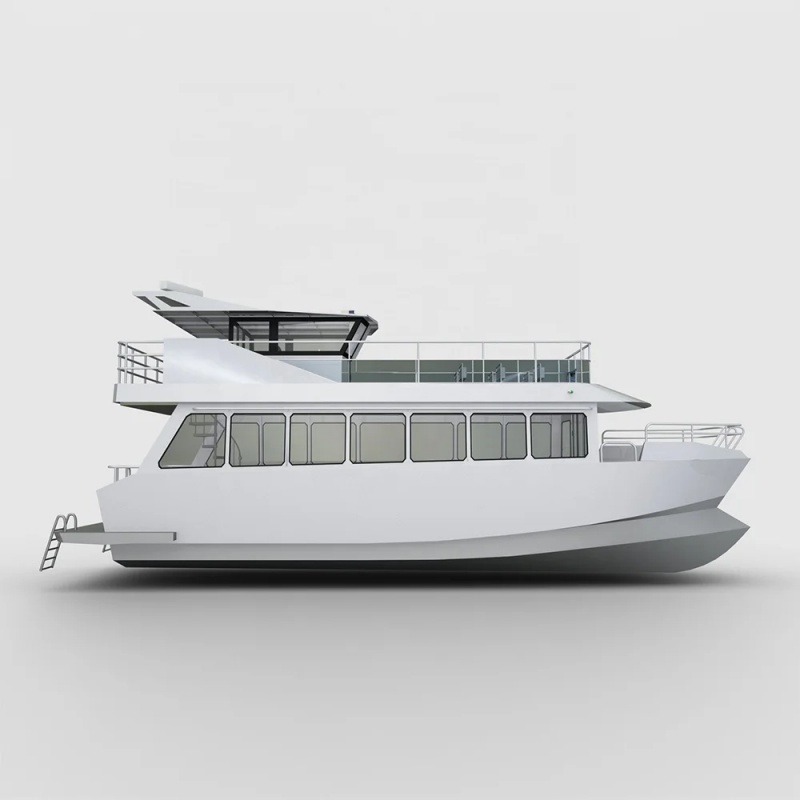
The structural foundation of your vessel dictates its performance, maintenance schedule, and lifespan. Comparing the primary structural options available for commercial vessels in this size class reveals distinct advantages for different operational profiles. Selecting the wrong hull form or material guarantees decades of operational friction.
Catamarans offer superior stability and a wider beam. They feature two slender hulls that slice through the water. This produces a significantly lower wake than a comparable monohull. They excel at maintaining passenger comfort in choppy waters, reducing the incidence of seasickness. The wide deck space allows for flexible passenger layouts and easier ADA compliance. Engine rooms in catamarans are widely separated, providing excellent redundancy. However, catamarans require wider slips for docking. They often incur higher haul-out costs due to their beam, requiring specialized travel lifts.
Monohulls provide traditional handling characteristics. They bank into turns, which feels natural to most operators. They often present a lower initial build requirement due to simpler construction methods. Monohulls fit better within tight docking footprint constraints and standard marina slips. They handle heavy bow-on seas well. However, they are more prone to rolling in beam seas, which compromises passenger comfort on certain routes. Monohulls generally offer deeper drafts, which provides excellent tracking but limits access to shallow waterways.
Hull Type | Primary Advantage | Operational Limitation | Best Route Application |
|---|---|---|---|
Catamaran | High stability and low wake wash | Requires wider docking facilities | Shallow draft routes, sensitive harbors |
Monohull | Fits standard marina infrastructure | Higher roll in beam seas | Deep water, narrow docking channels |
Marine-grade aluminum, specifically 5083-H116 and 5086 alloys, offers exceptional durability. Structural repairs remain straightforward for qualified aluminum welders. Its lightweight nature boosts fuel efficiency and allows for higher speeds with less horsepower. Aluminum does not rust, but it requires careful electrical isolation to prevent galvanic corrosion. Stray current in a marina can severely damage an unprotected aluminum hull in weeks. It remains the dominant material for fast ferries due to its strength-to-weight ratio.
Composites and fiberglass provide excellent corrosion resistance. They require lower hull maintenance in high-salinity climates. The smooth finish reduces hydrodynamic drag. Modern resin infusion techniques create incredibly strong, lightweight structures. However, structural modifications involve higher complexity. Repairing impact damage requires controlled environments, specific humidity levels, and specialized resin work. Osmosis blistering can also occur in older composite hulls if not properly barrier-coated with epoxy.
Steel delivers ultimate durability. It suits heavy-duty operations, debris-filled rivers, or ice-class routes perfectly. Steel withstands impacts that would breach aluminum or fiberglass. However, the heavy weight penalty directly impacts fuel consumption and limits top speed. Steel also requires rigorous coating systems and active cathodic protection to fight rust. This demands a highly proactive maintenance schedule, including frequent needle-scaling and epoxy touch-ups to prevent structural degradation.
Choosing the exact capacity requires balancing peak demand against off-peak inefficiencies. The operational differences between the lower and upper ends of this capacity spectrum are profound. Overcapitalizing on capacity drains resources, while undercapitalizing leaves revenue on the table.
Analyze historical ridership data meticulously. Look at seasonal peaks, weekend surges, and daily commuter spikes. This data justifies upgrading to a 100 passenger ferry boat. If your route consistently turns away passengers during peak hours, the larger vessel captures that lost revenue. You must model the exact break-even point for the larger vessel based on your specific ticket yields.
You must understand the concept of dead weight. Operating a half-empty 100-seat vessel incurs a massive fuel penalty. You push extra hull surface area and structural weight through the water for no financial return. In many scenarios, running a 50 passenger ferry boat at high frequency proves more efficient. High-frequency schedules often attract more riders because passengers prefer shorter wait times over larger vessels. A nimble, smaller vessel allows you to adjust schedules dynamically based on real-time demand.
To optimize your load factors, implement these tracking methods:
Install automated passenger counting systems at boarding gates.
Analyze ticket sales data by the hour to identify micro-peaks.
Run simulated schedules comparing two smaller vessels against one large vessel.
Survey existing passengers regarding their preferred departure frequencies.
Track seasonal weather patterns against ridership drop-offs.
Passenger counts and gross tonnage directly dictate minimum safe manning documents. A 50-passenger vessel might operate legally with a captain holding a Master 50-Ton license and one deckhand. Pushing capacity to 100 passengers often mandates additional deckhands to manage emergency evacuations and crowd control. This instantly doubles your daily crew payroll. You must factor these recurring labor expenses into your long-term financial models.
Crossing specific passenger thresholds also triggers stricter regulatory frameworks. Moving into a higher classification mandates additional lifesaving equipment, larger life rafts, and more complex structural fire protection. You may need A-60 fire-rated boundaries around the engine room, fixed firefighting systems, and redundant steering gear. These regulatory upgrades add significant weight and complexity to the build. Compliance inspections become more rigorous, requiring more administrative overhead from your operations team.
The engine room is the mechanical heart of your operation. Analyzing the shift from traditional to alternative propulsion, alongside onboard power demands, ensures long-term viability. Propulsion choices dictate your daily operating expenses more than any other vessel component.
Tier 3 and Tier 4 compliant marine diesel engines offer proven reliability. Maintenance expertise remains widespread. You can find a qualified diesel mechanic in almost any port. Upfront capital requirements are generally lower than alternative propulsion systems. Modern common-rail diesels provide excellent fuel economy and torque. They handle continuous heavy loads exceptionally well. However, Tier 4 regulations require Selective Catalytic Reduction systems. These systems demand dedicated space for Diesel Exhaust Fluid tanks and add complexity to the exhaust routing. You must manage DEF logistics alongside your standard fuel bunkering.
Electric propulsion suits short, high-frequency routes perfectly. Water taxis and harbor crossers benefit immensely from the instant torque and silent operation of electric motors. The reduction in localized emissions and engine noise dramatically improves the passenger experience. Lithium Iron Phosphate battery banks provide excellent safety profiles and deep cycling capabilities for marine environments.
Infrastructure requirements represent the biggest hurdle. You need robust shore charging capabilities. Megawatt charging systems require substantial grid capacity at your docking facility. Upgrading local grid infrastructure requires heavy capital investment. Grant funding can offset this initial outlay. Long-term operational reductions—through eliminated fuel consumption and drastically reduced engine maintenance—make electric propulsion highly viable for specific routes. You eliminate oil changes, fuel filter replacements, and exhaust system maintenance entirely.
Marine generator sets support onboard electrical networks. Modern vessels require substantial 400V/230V AC power. You cannot rely solely on main engine alternators for commercial operations. Dedicated generators provide clean, stable power for sensitive navigation electronics and heavy hotel loads.
Robust HVAC systems demand heavy power, especially in extreme climates. Commercial galleys for dinner cruises draw massive loads for ovens, refrigeration, and dishwashers. Entertainment systems, lighting, and navigation electronics add to the draw. You must execute precise load calculations. Factor in the starting surge of large electric motors like HVAC compressors. Undersized generators lead to voltage drops, tripped breakers, and catastrophic power failures during transit. Always specify parallel generators for redundancy on passenger routes. If one generator fails, the second unit must seamlessly handle the critical loads to safely complete the voyage.
Operators must choose between commissioning a new build or purchasing an existing vessel on the brokerage market. Compare these acquisition pathways carefully to reduce buyer risk. Each path carries distinct operational and financial implications.
Specifying exact propulsion, hull form, and layout brings massive operational benefits. A custom passenger ferry boat matches your route perfectly. You optimize the hull for your specific cruising speed, minimizing fuel burn. You design the boarding gates to align exactly with your existing docks, shaving minutes off every turnaround. You select the exact engine packages that your local mechanics are certified to service.
The primary risks include extended lead times. A custom build typically takes 12 to 24 months from contract signing to delivery. It also requires higher initial capital. You must manage shipyard milestone payments and oversee the construction process. This requires a dedicated project manager or naval architect to conduct regular shipyard inspections. You must verify weld quality, coating applications, and system installations before the vessel leaves the builder's yard.
Used vessels offer immediate availability. You can launch a new route in weeks rather than years. The lower initial outlay preserves capital for marketing and initial operating expenses. Brokerage vessels allow operators to test unproven routes without committing to a multi-year build process.
Mitigation steps are critical when buying a used commercial ferry boat. Never purchase a vessel without a mandatory out-of-water marine survey. Conduct ultrasonic hull thickness testing to find localized corrosion or plate thinning. Perform comprehensive engine oil analysis to uncover hidden bearing wear or coolant leaks. Inspect all electrical panels using thermal imaging to identify loose connections or overloaded circuits. Check cutlass bearings and rudder posts for excessive play. Deferred maintenance can quickly erase any savings gained from a lower initial outlay.
Rigorous sea trials under fully loaded conditions are non-negotiable. An empty vessel performs vastly differently than one carrying 100 passengers and full fuel tanks. Test crash stops, high-speed turns, and single-engine maneuvering. Verify that the HVAC system maintains cabin temperature under full sun with a simulated passenger heat load. Record fuel consumption at various RPMs to validate the seller's performance claims.
Secure commercial marine financing early in the process. Lenders require extensive documentation, including route feasibility studies and cash flow projections. Obtain specialized hull and machinery and protection and indemnity insurance quotes before finalizing the purchase. Insurance premiums vary wildly based on vessel age, hull material, and passenger capacity. A vessel that requires a massive insurance premium due to its age or construction material severely impacts your monthly operating budget.
Providing a strict financial evaluation lens separates successful operators from those who struggle. You must look beyond the initial acquisition and model the lifecycle economics of the vessel. A holistic view of your financial commitments ensures long-term sustainability.
A vessel with a low acquisition cost often hides high fuel consumption. Inadequate auxiliary power and frequent maintenance needs turn a bargain into a liability. Spending extra upfront on a highly efficient hull design and premium engines often pays for itself within the first three years of operation through fuel savings alone. Operating expenses drain cash flow daily. Capital expenditures can be amortized over decades. You must calculate the exact fuel burn per passenger mile to understand your true operating margins.
Factor in mandatory regulatory dry-docking intervals. Depending on your classification society and local regulations, you must haul the vessel out of the water every two to five years. Dry-docking involves hull cleaning, antifouling application, shaft seal replacement, and valve inspections. You must also replace sacrificial zinc anodes and inspect all underwater running gear.
Calculate the cost of route downtime. When your primary vessel is in the shipyard, you generate zero revenue unless you have a backup vessel. Planning service interruptions during the off-season is essential. Build a financial reserve specifically for dry-docking and unexpected major component failures. Implementing a computerized maintenance management system tracks component lifespans and prevents catastrophic underway failures.
Maintenance Activity | Typical Frequency | Operational Impact |
|---|---|---|
Engine Oil & Filter Changes | Every 250-500 hours | Minimal (Overnight service) |
Top-End Engine Overhaul | Every 10,000 hours | Moderate (1-2 weeks downtime) |
Regulatory Dry-Docking | Every 2-5 years | High (Requires shipyard haul-out) |
Antifouling Paint Renewal | Every 24-36 months | High (Combined with dry-docking) |
To move forward with your vessel procurement, execute the following steps:
Hire a certified naval architect to conduct a comprehensive route feasibility study, defining exact draft, speed, and capacity limits.
Compile three years of historical ridership data or projected demographic studies to finalize your exact seating capacity requirements.
Draft a detailed Request for Proposal specifying your required hull material, propulsion type, and regulatory classification.
Submit the RFP to at least three qualified shipyards or commercial brokers to compare build timelines and technical specifications.
A: Lifespans depend heavily on hull material and maintenance. Marine-grade aluminum hulls typically last 20 to 30 years. Steel hulls can operate for 40 years or more if corrosion is strictly managed. Composite hulls generally offer 25 to 35 years of service. Consistent preventive maintenance, regular dry-docking, and mid-life engine refits significantly extend these operational lifespans.
A: The final outlay fluctuates based on propulsion choice, hull material, and regulatory classification. High-speed aluminum catamarans require higher initial capital than displacement steel monohulls. Advanced hybrid or fully electric propulsion systems significantly increase initial build requirements compared to traditional diesel. Custom amenities, commercial galleys, and high-end HVAC systems also drive up the final shipyard invoice.
A: In the United States, vessels carrying more than six passengers operate under USCG regulations. A 50-passenger vessel typically falls under Subchapter T for vessels under 100 gross tons and under 150 passengers. This dictates strict standards for intact stability, structural fire protection, lifesaving equipment, and minimum safe manning levels. International operators follow similar local maritime authority rules.
A: Buying used offers immediate availability and lower initial capital outlay, making it ideal for testing new routes. Commissioning a custom build provides optimized fuel efficiency, exact layout matching, and full warranties. Custom builds generally deliver better long-term operational economics, while used vessels minimize upfront financial risk.
A: Yes, but retrofitting presents severe technical challenges. Batteries add massive weight, altering the vessel's center of gravity and stability profile. Finding adequate hull space for battery banks and managing the thermal loads is difficult. A purpose-built electric vessel is always more efficient than a retrofitted diesel hull.


